
Back to the home and research evidence page · Understanding a fair CHC assessment
NHS Continuing Healthcare decisions and experiences in England
A formal mixed methods evidence review with convergent integrated synthesis
About this page: the full supplied updated formal review dated 10 October 2026, including the structural-tensions discussion amendment and its reporting limitations. The review is not presented as having comprehensive systematic search coverage or as a peer-reviewed publication.
Reading support: blue “In simple terms” boxes are explanatory material, separate from the formal research text. The explanation supplied in section 4.2 is retained; the other boxes were added for this web page. They do not add new research findings. Personal-name redaction is retained; cited research authors remain identified.
General information about CHC in England. This page is not legal, medical or financial advice and cannot determine an individual’s eligibility.
Abstract
Background
NHS Continuing Healthcare (CHC) provides NHS-funded care for adults assessed as having a primary health need. Its processes determine access to support at the boundary between health and social care. Decision statistics alone do not describe participation, the implementation of care or the consequences of unresolved journeys.
Objective
To examine reported decision outcomes, experiences and consequences across CHC access, assessment, funding implementation, review and challenge processes in England, and the factors associated with or proposed to explain these findings.
Methods
Convergent integrated synthesis retained numerical denominators alongside textual findings. One human reviewer worked with AI assistance. The retained archive contained 996 imported references and 545 deduplicated records. A retrospective PRISMA-informed flow reconciles these records and a 37-entry grey inventory; complete search yields and full-text stage totals could not be verified.
Results
The reconciled inventory contains 42 core source entries and two supporting documentary entries, with three linked companions. These are not independent-study totals. Seven themes address participation, timeliness, variation, implementation, organisational boundaries, challenge and representation. Selection, missing methods, incompatible measures and confounding limit inference.
Conclusion
The evidence distinguishes obtaining an eligibility decision from receiving appropriate care through an understandable and participatory process. It supports bounded accounts of local outcomes and experiences but does not establish national decision-error rates or causal effects. Direct patient experience, dementia-specific outcomes and linked decision-to-care trajectories remain important evidence gaps.
1. Introduction and background
For a family supporting someone with severe illness or disability, a funding process can become part of the experience of illness itself. Evidence must be assembled, needs explained, correspondence pursued and decisions challenged, often while the person’s condition changes. The available family accounts and investigated cases illustrate how these tasks can add to the work of supporting care, although their frequency and cumulative effects are not established nationally. (Healthwatch Lambeth, 2023; Parkinson’s UK and Continuing Healthcare Alliance, 2016; Parliamentary and Health Service Ombudsman, 2020)
NHS Continuing Healthcare (CHC) provides NHS-arranged and funded care for adults in England assessed as having a primary health need. The 2022 National Framework, corrected in July 2023, describes assessment in terms of the nature, intensity, complexity and unpredictability of needs, alongside expectations concerning participation and decision-making. This review uses the framework as a policy reference rather than assuming that its existence establishes consistent implementation. CHC connects clinical assessment with organisational responsibilities, funding and the practical availability of care. (Department of Health and Social Care, 2022b)
The distinction between NHS-funded healthcare and means-tested social care gives CHC decisions substantial practical and financial significance. An assessment can affect whether care is funded, which services can be arranged and what responsibilities fall to families. These consequences are not captured by a single classification of a claim as successful or unsuccessful. A person may obtain eligibility but still lack an appropriate provider; a challenged decision may lead to reassessment without an implemented award; and a complaint may identify a procedural failure without determining eligibility. (Hutchings et al., 2025; National Audit Office, 2017; Parliamentary and Health Service Ombudsman, 2020)
CHC is also a continuing process rather than one decision. The pathway can include awareness and referral, initial screening, multidisciplinary assessment, a funding decision, care implementation, routine review, eligibility reassessment and challenges to a decision. Retrospective assessment introduces additional questions about the period reviewed and the distinction between eligibility, agreed reimbursement and payment received. These stages can recur and overlap. Standard CHC and Fast Track require separate interpretation because their purposes, assessment routes and urgency differ. (Department of Health and Social Care, 2022a, 2022b)
Patient and family experience encompasses more than the outcome of an eligibility decision. The CHC pathway may itself become part of the experience of illness and care, as individuals and families navigate assessment, waiting, funding implementation, review and challenge alongside changing needs. Uncertainty about decisions, timescales, responsibilities and future care provides a useful focus for examining these experiences. This review therefore considers both what decisions are reported and how the processes surrounding them are experienced. Uncertainty explicitly reported in a source is distinguished from uncertainty inferred through the review’s interpretation. (Healthwatch Enfield, 2020; Healthwatch Gateshead and Newcastle, 2018; Healthwatch Lambeth, 2023; Parkinson’s UK and Continuing Healthcare Alliance, 2016; Parliamentary and Health Service Ombudsman, 2020)
The pathway, not the individual encounter, is the appropriate unit of experience. This is the conceptual framing adopted by the review: individual encounters are examined within a continuing journey, where earlier decisions, waiting and repeated explanations may shape later experiences. It does not assume that each source follows a complete pathway or change the statistical unit of analysis used in an included study.
Published evidence describes problems with access, communication, timeliness and the provision of care, but these reports arise from different populations and methods. Ombudsman investigations can substantiate failures in selected cases. Community surveys and interviews describe experiences among participating recipients and families. Administrative datasets quantify activity and selected outcomes but rarely capture individual understanding or participation. Professional accounts offer explanations for practice while remaining distinct from the experiences of people receiving care. Each perspective contributes to the review, but none can substitute for all the others. (Healthwatch Enfield, 2020; Healthwatch Gateshead and Newcastle, 2018; Healthwatch Lambeth, 2023; Hutchings et al., 2025; National Audit Office, 2017; NHS England, 2024, 2025, 2026a, 2026b; Parkinson’s UK and Continuing Healthcare Alliance, 2016; Parliamentary and Health Service Ombudsman, 2020)
Variation is another important concern. National and local analyses describe differences in eligibility and practice, while professional accounts identify awareness, evidence gathering, interpretation, commissioning and relationships as possible influences. These observations raise questions about consistency and access. However, differences between localities may also reflect population needs, referral patterns and data definitions. Aggregate variation does not by itself establish inequity or the correctness of individual decisions. (Hutchings et al., 2025; National Audit Office, 2017; NHS England, 2024, 2025, 2026a, 2026b)
Concerns about CHC recur across policy periods. The Public Accounts Committee criticised delays, awareness and variation in 2018. More recent analyses from Age UK and the Nuffield Trust describe concerns about access, care implementation and organisational relationships. This recurrence warrants examination, but reports using different methods, populations and measures cannot be treated as a single measure of unchanged performance. (Age UK, 2024; House of Commons Committee of Public Accounts, 2018; Hutchings et al., 2025)
Despite these concerns, the evidence assembled for this review suggests that CHC decision processes and their cumulative effects on adults and family carers remain under-researched. Detailed primary studies following people through assessment, funding decisions, implementation, withdrawal and challenge are limited within the retained evidence. Direct accounts from adults, particularly people with dementia, are also scarce. Academic reports include local clinical, service-improvement and professional research, but do not establish a comprehensive account of the lived experience of the CHC journey. (Deaney et al., 2024; Healthwatch Enfield, 2020; Healthwatch Gateshead and Newcastle, 2018; Healthwatch Lambeth, 2023; Hutchings et al., 2025; Morrison et al., 2023, 2024)
The gap is not an absence of primary evidence about CHC. Some charitable, Healthwatch and policy reports contain original surveys, interviews or mixed methods research. Grey literature is therefore an important source of primary findings as well as administrative and investigated evidence. The limitation concerns the depth, methodological transparency, coverage and linkage of evidence about decisions, experiences and consequences. This distinction avoids equating publication outside an academic journal with a lack of original research. (Healthwatch Enfield, 2020; Healthwatch Gateshead and Newcastle, 2018; Healthwatch Lambeth, 2023; Hutchings et al., 2025; Parkinson’s UK and Continuing Healthcare Alliance, 2016)
The project initially focused on mapping patients’ and families’ experiences. The current review adopts a broader adult England question and a mixed methods evidence-review design to integrate decision outcomes with experiential and explanatory evidence. The small evidence base does not itself preclude a systematic or scoping review. Rather, it makes transparent searching, appraisal, source-family linkage and cautious integration especially important. Personal family experience informs reflexivity and the rationale; it is not included as a primary study in the core synthesis. Complete executed search histories could not be recovered. The design designation is therefore qualified; the retained evidence is not presented as comprehensive systematic coverage.
A mixed methods synthesis is appropriate because numerical and experiential evidence can address shared questions about CHC processes and consequences. Convergent integrated synthesis permits quantitative findings to be expressed as bounded textual statements and examined with qualitative findings, while preserving the original estimates and denominators. This supports examination of agreement, complementarity and contradiction rather than assuming that different evidence types confirm the same explanation. (JBI, n.d.)
This review concerns adults in England, with dementia retained as an explicit subgroup. It examines both decision outcomes and experience across the CHC journey. The contribution is to clarify what is documented, what is reported, what remains explanatory and where evidence is missing. It does not assume that a refusal is incorrect, an award demonstrates a fair process or an association establishes a causal effect.
1.1 Review questions
Primary question: What decision outcomes, experiences and consequences are reported in relation to NHS Continuing Healthcare access, assessment, funding implementation, review and challenge processes for adults in England, and what factors are reported to influence or be associated with these findings?
RQ1 Decision outcomes: What awards, refusals, withdrawals, reinstatements, changed decisions, retrospective eligibility and unresolved outcomes are reported at each pathway stage?
RQ2 Experience and consequences: How do adults, unpaid carers and representatives experience the processes, and what consequences do they report for participation, dignity, wellbeing, finances and care continuity?
RQ3 Factors and explanations: Which clinical, documentary, organisational and representational factors are associated with outcomes or are reported as barriers and facilitators, and how credible are these explanations?
RQ4 Context and integration: How do findings vary by pathway, policy period, locality, clinical needs and perspective, and where do numerical and experiential findings agree, complement or contradict one another?
2. Methods
2.1 Design and protocol
The review uses a mixed methods design with convergent integrated synthesis, informed by JBI guidance. Protocol version 5, dated 4 October 2026, defines the adult England scope and analytical boundaries. Quantitative findings were retained in their original form and translated into textual statements for integration with experiential and explanatory findings. PRISMA 2020 guides reporting, and PRISMA-S guides documentation of the search; neither is treated as an appraisal instrument. (JBI, n.d.; Rethlefsen et al., 2021)
An amendment dated 5 October 2026 records that the planned independent second-reviewer procedures were not implemented. One human reviewer worked with ChatGPT assistance in screening support, extraction, appraisal and synthesis. AI assistance does not constitute independent review. The human reviewer retains responsibility for eligibility decisions and reporting. The author confirmed on 10 October 2026 that the review was not registered and was self-funded without external support. A 10 October reconciliation corrected historical project-value exclusions under the broad protocol; this retrospective amendment does not imply prospective registration.
2.2 Eligibility
Eligible evidence concerns adults aged 18 years or older undergoing formal CHC processes in England, their unpaid carers or representatives, or relevant professionals. Reports must provide extractable findings relevant to at least one research question. The publication period begins in 2007, with underlying care and decision periods recorded separately. UK-wide or mixed-age evidence requires separable England adult findings. Standard CHC and Fast Track are tagged separately; NHS-funded nursing care is retained only where linked to a CHC process.
Eligible sources include empirical qualitative, quantitative and mixed methods studies, transparent audits and surveys, administrative analyses and documented investigations. Unsupported opinion and generic clinical or continuing-care material without an explicit CHC process link are excluded from the core synthesis. Reviews, policy and legal material inform context or citation searching. Inaccessible sources do not contribute assumed findings. The reviewer’s family documents and unsupported forum posts are outside the core evidence synthesis.
2.3 Information sources and search reporting
The retained 4 October 2026 archive contains imported groups labelled ProQuest (293), Embase (195), five Trip searches (231 in total), PubMed (104), CINAHL (82), CINAHL Plus (82) and Open Dissertations (9): 996 imported references. These are archive counts, not verified complete search yields. Exact executed histories, platform editions, limits and some dates are unavailable in the retained record. Grey extraction is dated 5 October. Targeted source reconciliation on 10 October was not a comprehensive update search. Illustrative queries in the Starting point file are not presented as executed searches. The search audit accompanies this formal review; PRISMA-S reporting remains incomplete.
The broad strategy prioritises CHC terminology, with supplementary NHS and process terms for ambiguous historical expressions. Dementia is a subgroup rather than a mandatory population filter. Source-family linkage is used to identify repeated publications, revisions and overlapping administrative data. Exact executed searches and deviations should be retained in the search appendix rather than reconstructed from memory. (Rethlefsen et al., 2021)
2.4 Selection and extraction
Source-level dispositions and full-text reasons were recorded. Companion publications were linked, and the most complete applicable report was used for overlapping numerical findings. Morrison’s 2022 preprint was superseded by the 2023 final publication. Relevant findings were extracted with source identifiers, locators, dates, setting, sample, perspective, pathway, journey stage and interpretive limits. Funding decisions, recommendations, implemented care and remedies were treated as distinct outcomes.
Deduplication removed 451 imported copies, leaving 545 database records. Title screening excluded 342 and routed three to context; 200 received abstract or bibliographic screening. Their final dispositions were 80 exclusions at available-source stages, 55 context entries, four duplicate source fragments, 28 reports not retrieved and 33 retained source/companion entries. The retained database entries comprise 28 core entries, two supporting documentary entries and three companions. The 37-entry grey inventory comprises 18 core entries, 16 context or historical entries and three entries whose source identities remain unverified. Four grey core entries are also indexed in the database ledger and are counted once across routes. The combined inventory therefore contains 42 core synthesis source entries, two supporting documentary entries and three companions. Figure P1 presents this reconciliation; Appendix L records its arithmetic and limitations.
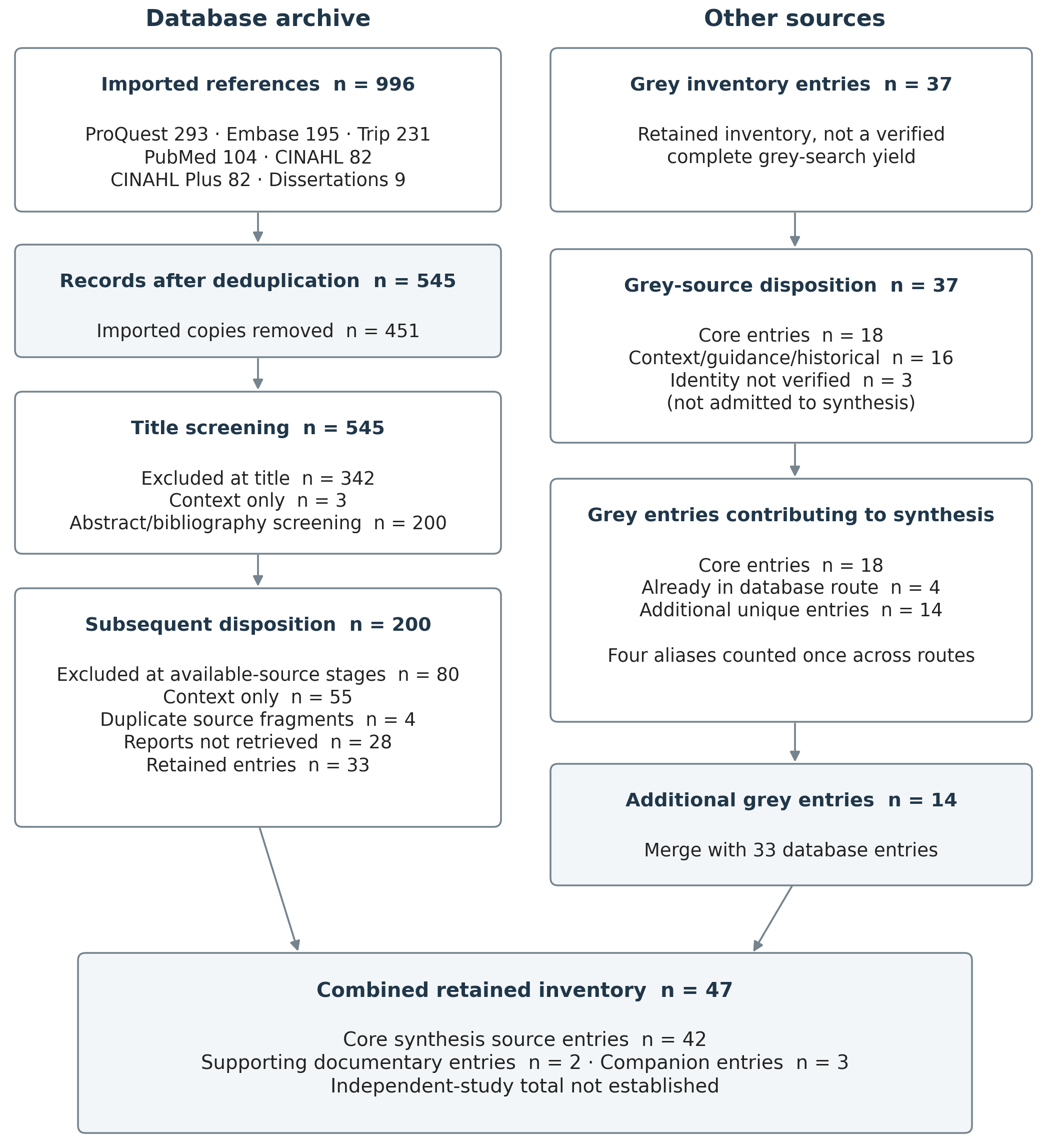
Counts refer to imported records and retained source entries. Complete search yields, full-text assessment totals and independent-study totals are not recoverable from the retained audit. This adapted flow does not imply that every screened item was retrieved in full.
2.5 Critical appraisal and risk of bias
MMAT 2018 was used for applicable empirical design components. Other contributing sources were assessed using protocol domains covering authority, aim, methods, coverage, objectivity, date and significance, with additional documentary checks where appropriate. Criterion-level reasons and locators were retained. No summed quality score was calculated, and methodological weakness alone was not an automatic exclusion. (Hong et al., 2018)
Risk of bias was displayed using review-specific narrative domain profiles derived from these appraisals: selection and coverage; measurement and classification; missing data and nonresponse; confounding; analysis and interpretation; selective reporting; and interests and reflexivity. Judgments were concern, unclear, no concern identified within scope, or not applicable. This profile is not a validated new instrument or a formal ROBINS-I or RoB 2 assessment, and no overall source-level grade was assigned. Appraisal influenced interpretation and narrative removal checks. Detailed evidence and source-contribution matrices are included in this review; criterion-level extraction and appraisal files are retained in the accompanying audit package.
2.6 Quantitative analysis and integrated synthesis
Numerical findings were summarised within their original pathway, period, unit and denominator. Three local cohort proportions received exploratory, review-calculated two-sided 95% Wilson intervals on 5 October 2026. These are model-based precision summaries for comparable observations, not corrections for selection, confounding or incomplete ascertainment. Administrative changes and selected challenge outcomes remained descriptive. Source-reported associations were distinguished from review calculations. No meta-analysis or new hypothesis testing was performed. (NIST/SEMATECH, n.d.)
Additional descriptive comparisons completed on 6 October 2026 use the retained NHS England quarterly releases (NHS England, 2024, 2025, 2026a, 2026b) and historical NHS Digital data (NHS Digital, 2017). Percentages and changes were calculated from reported counts, with completed assessments, completed referrals, outstanding referrals and recipient stock kept separate. England, Cheshire and Merseyside and Warrington are nested populations, not independent samples. Local rows were selected because of their relevance to the reviewer’s family context; this was not an exhaustive geographical comparison. Historical endpoints provide context rather than a harmonised time series. The statistical comparison and figures are review outputs, not additional independent evidence sources.
A joint display in Appendix J links the additional numerical findings to the analytical themes and research questions. Relationships are classified as complementary evidence or contextual information; no individual-level linkage is assumed. The historical comparison remains contextual and does not supply an additional core-study contribution.
Quantitative findings were translated into bounded statements and examined alongside experiential and professional findings. Seven provisional analytical themes were developed from the extracted material. Sources may contribute to more than one theme while retaining a single finding identifier. Theme definitions and the source-to-theme matrix appear in Appendix G. Original quantities and numerical qualifications appear in Appendix H and the companion workbook. Agreement, complementarity, contradiction and alternative explanations were considered; numerical frequency was not inferred from qualitative recurrence.
Narrative sensitivity checks considered removing selected complaints, weakly described surveys, financial testimony, clinical case reports and uncontrolled improvement evidence. These checks identify which forms of support or illustrations are lost; they are not pooled sensitivity estimates or formal certainty grades. Bias due to missing studies or results was not formally assessed. The heterogeneous unpooled results did not supply a common effect estimate for a funnel plot or publication-bias test.
The final source-to-theme transformation summary (Appendix M) was prepared retrospectively on 10 October 2026. It preserves quantities, denominators and perspective, supplies three worked numerical transformations and maps each of the 42 core source entries to bounded textual findings. It is not an original prospective coding log. Appendix N documents narrative removal considerations for all seven themes; these are interpretive sensitivity checks rather than statistical robustness tests. Appendix O identifies completed reporting and the unresolved executed-search and full-text-stage gaps.
3. Results
3.1 Evidence characteristics and appraisal
The reconciled core inventory contains 42 source entries; two additional trade-press reports provide supporting documentary context. Three companion entries are linked to primary sources without independent contributions. Material includes administrative statistics, selected complaints, local experience reports, institutional scrutiny, policy research, professional ethnography, clinical cases and Fast Track audits/improvement reports. Newly resolved eligible evidence comprises ten published-abstract reports and Dalingwater’s full journal article. Abstract-only contributions are distinguished from full-report evidence. Two supplied grey sources contribute only their adult England-attributable components. Source entries and recurring administrative releases are not independent studies; study/data overlap is retained as an interpretation constraint.
Appraisal identified self-selection, uncertain nonresponse and incompletely described analysis in several experience sources. Complaint and challenge series are selected populations. Administrative data offer defined measures but require attention to changing definitions and denominators. The CareFFuL historical comparison is susceptible to confounding from selection and concurrent changes. These limitations constrain population and causal inference without invalidating every bounded observation.
Dalingwater (2018) provides original interviews with 31 CHC managers and an analysis of 40 published testimonials. These offer contrasting professional and applicant/representative accounts of referral, assessment, review and challenge, with secondary statistical context. Only 31 of 130 invited teams participated; selection of testimonials, coding, reflexivity and several data-collection procedures are insufficiently reported. The study supports exploratory explanations and selected experiences rather than an adjusted estimate of inequity or the prevalence of incorrect decisions. Its earlier abstract-based mixed methods designation has been replaced by a primarily qualitative appraisal.
3.1.1 Included evidence matrix
Table 1 summarises the 42 core source entries admitted to synthesis. Table 2 identifies the two supporting documentary entries separately. Source IDs match the selection ledger and Appendix G.2; ADD-01 is the CHC-0043 alias. Historical GL17–GL18, database/grey aliases and linked companions do not create additional rows. Entries represent sources, not verified independent studies. Findings are bounded to the sampled people, reporting periods and available source text; repeated data are used once in synthesis.
Table 1. Core included evidence (42 source entries)
Source / entry |
Design, setting and evidence basis |
Bounded extracted findings |
Appraisal and interpretation limits |
|---|---|---|---|
CHC-0043 |
Retrospective clinical case series |
Three selected rural adult cases described funding awards that were difficult to implement because agencies could not be sourced. Families supplied additional care; one person with COPD and Alzheimer’s disease moved to a fully funded care home distant from family. Deterioration and distress were clinician-reported, without independent outcome measurement. |
Selected three cases without a sampling denominator or analytic procedure. Deterioration and family effects reported, not independently measured. No causal or prevalence inference. |
CHC-0065 |
Nonrandomised quality improvement project |
Phase 2 included 104 people: 94 were discharged home, with a median wait of one day. Ten died on the ward or were judged too near death/unstable to transfer (Results wording). Median survival among those discharged was nine days. Fifty of 104 had a CHC application, of which 41 were approved. Equipment, communication and funding sequencing changed together; selected family feedback described support and a peaceful home setting. |
Uncontrolled historical comparison, selected pathway, multiple simultaneous changes and expansion. Feedback has no sampling denominator or qualitative analysis. Costs modelled. Phase boundaries need verification. |
CHC-0094 |
Quantitative descriptive prospective service evaluation |
Among 439 Fast Track referrals in 2021, 413 died during follow-up; median survival was 15 days. Death before discharge occurred in 129/439 (29.4%). Median survival was 18 days for approved applications and 25 for deferred applications (reported p=0.0013); categories overlap and comparisons are unadjusted. |
One local referred cohort. Approval, deferment and death categories overlap. Unadjusted survival comparisons cannot establish mortality caused by deferment. Capture beyond local records uncertain. |
CHC-0112 |
Qualitative ethnography |
Eight professionals in one English acute trust described funding-panel difficulties, restricted placement options and moral distress. These are professional accounts, not an audit of whether individual refusals were correct. |
One trust; selected staff perspective; limited reflexivity; patients and carers not interviewed for this report. |
CHC-0138 |
Published conference audit abstract |
In an audit of 99 medically fit older inpatients, the mean wait from referral to CHC-team assessment was 8.75 days. The number referred to CHC was not separately reported. |
Single hospital; subgroup denominator unavailable. Cohort complications, deaths and total excess bed costs cannot be attributed to CHC delays. |
CHC-0148 |
Published quality-improvement abstract |
Among 68 Fast Track-funded discharges, recorded Universal Care Plan completion increased from 33% to 75% across the reported quarters following education and template prompts. |
Quarter-specific numerators and denominators unavailable; uncontrolled changes; documentation completeness is not measured lived experience or care quality. |
CHC-0149 |
Published service-development abstract |
An English hospice developed a young-adult service for four people. CHC funding was explicitly obtained for the motivating young person to support staffing; the abstract does not establish CHC funding for all four. |
Very small service description; ages and systematic outcome evaluation absent. Use only the separable adult service and identified funding implementation account. |
CHC-0157 |
First-year Fast Track service evaluation |
The home-care service reported 156 referrals in its first year, 75 people supported to die at home, and a referral-to-care interval of 24–48 hours. |
Referrals may not equal unique eligible people. No concurrent comparator, completeness assessment or case-mix adjustment is reported. Home deaths cannot be interpreted as an intervention effect. |
CHC-0158 |
Published discharge-summary re-audit abstract |
A re-audit examined 181 Fast Track discharge summaries. Recorded GP instructions increased from 46% to 62% and anticipatory prescriptions from 80% to 94%, while follow-up-plan documentation fell from 61% to 47%. |
Earlier audit denominators and adjustment unavailable. Readmission wording conflicts with the reported 9% and 16%; withhold that direction and any causal explanation. |
CHC-0160 |
Published mixed-methods service-evaluation abstract |
Of 72 Bristol Fast Track referrals, 27 died in hospital, 30 were discharged with funding and 15 without it. Thirteen staff interviews identified paperwork, communication, recognition and staffing barriers. |
Conference-level reporting; missingness, sampling and formal integration unclear. The printed end date “31 April” is impossible; retain March–April 2021 with exact dates unverified. These are not causal effects. |
CHC-0165 |
First-month Fast Track service evaluation |
All reported first-month care was delivered within 48 hours; 88.9% achieved preferred place of death. |
Denominators and completeness are absent. No confidence interval or causal effect can be estimated; this is a short local implementation report. |
CHC-0173 |
Retrospective audit of cirrhosis deaths |
The audit reports that 62.5% of community palliative-care referrals occurred in a Fast Track discharge context. Extract only this CHC-related observation. |
The 52 deaths are not a CHC cohort. The percentage denominator is absent. Selection on death and retrospective documentation restrict interpretation. CHC-0178 reports the same cohort and is linked. |
CHC-0188 |
Rapid personalised care service pilot |
Reported care within 48 hours was 99%; preferred-place achievement rose from 79% to 90%; 95% of referrals were said to meet local service criteria. |
Denominators, comparator periods and case mix are absent. Local criteria are not national eligibility rates. The abstract’s reference to a 12-week criterion must not be presented as a national Fast Track prognostic rule. |
CHC-0190 |
Before-and-after Fast Track improvement report |
Reported total length of stay decreased from 22 to 16 days; admission-to-Fast-Track decision from 15 to 13 days; Fast Track process time from seven to 2.5 days. Estimated value of 2,052 bed days at £300/day was £615,600. |
Multiple interventions, unknown case mix and no concurrent control prevent causal attribution. Intervals need not be additive. The financial figure is a modelled bed-day value, not verified cash savings. |
CHC-0194 |
CHC-funded homecare service evaluation |
The CHC-funded service supported 32 patients and delivered 1,147 care hours. Reported Fast Track discharge delay fell from 15.3 days to less than two days. |
The baseline cohort size and measurement periods are unspecified. Care availability and commissioning changed together; without adjustment or control the reduction is descriptive. |
CHC-0204 |
Discharge audit and staff survey |
Staff reported anxiety about discharge documentation, particularly CHC funding paperwork. A discharge educator and patient leaflet were introduced. Broader hospice discharge results are not extracted as CHC-specific effects. |
Staff sampling, survey instrument and analysis are not described. Retrospective provider accounts do not establish patient or carer experience, or the effect of education. |
CHC-0209 |
Published before/after service-improvement abstract |
A Southampton discharge improvement programme reported mean days to discharge for Fast Track patients falling from 20 to 11. Overall evaluation samples were 50 before and 41 after; Fast Track subgroup sizes were not supplied. |
Multiple simultaneous interventions, small uncontrolled samples and unclear case mix. Overall complaints and adverse events are not Fast Track-specific outcomes. |
CHC-0215 |
Retrospective diversional-bed evaluation |
All 189 reported referrals were Fast Track funded. Of these, 109 came from home; 69% died within four weeks. Two hospice and three hospital transfers were reported. People surviving longer continued care in the nursing home. |
Referrals may not equal unique people. No unselected eligibility denominator, comparator or adjustment is provided. The abstract collection DOI is not an individual paper identifier. |
CHC-0240 |
Three-person rehabilitation and resettlement case series |
Following CHC review and withdrawal, three men with acquired brain injury moved into adapted community housing with multi-agency and family involvement. One later lived alone without support; two remained in shared supported housing. A proposal for residential placement on cost grounds was reported for one. |
Highly selected cases, no comparison and no eligibility evidence. Outcomes do not establish that withdrawal was appropriate. Professional descriptions do not substitute for directly collected lived-experience data. |
CHC-0251 |
Published retrospective comparative audit abstract |
The Bristol/Weston audit compared 81 Fast Track referrals with a selected non-referred cohort. Only 33 of 176 reviewed non-referred records remained after exclusions. Retrospective SPICT assessment suggested missed opportunities to recognise poor prognosis and refer. |
Heavy exclusions including 89 incomplete records; unmatched cohorts and retrospective classification. The 57.1% eligibility claim has an unclear denominator and is withheld from review-calculated rates. Admission/death/discharge windows differ within the abstract. |
CHC-0256 |
Qualitative interview and documentary testimonial study with secondary statistical context |
Forty published testimonials and 31 manager interviews identify referral barriers, information/training problems, inconsistent interpretation, managed-needs concerns, pressured reviews, financial boundaries and contested appeals. Selected accounts describe refusal of assessment, withdrawal and reinstatement with retrospective funding. Managers generally defend local assessment/training and deny unlawful rationing, while describing subjectivity, inconsistent reporting, joint funding and alternative services as explanations for variation. The author does not establish that geographic variation necessarily represents inequity. |
Managers: 31 of 130 invited teams participated; 99 declined or were unreachable. Published testimonials are selected secondary accounts, not prospectively recruited patient/carer interviews. Testimonial selection, identity/deduplication, interview recording/transcription, coding, reflexivity and ethics procedures are not reported in sufficient detail. No need-adjusted locality comparison or adjudication of individual eligibility; manager accounts may be socially desirable. Interpret proposed explanations and disagreements, not verified causal effects or national error/award rates. |
CHC-0271 |
Published hospice case-note audit abstract |
In 42 hospice Fast Track applications, 41 were approved and 39 received a decision within 48 hours. Preferred place of care/death was reported achieved for 28 of 42 people. |
Small selected hospice sample; timing definitions, missingness and outcome verification unclear. Approval, preferred-place outcomes and subsequent death are distinct measures. |
CHC-0284 |
Documented financial investigation in trade press |
An investigation of retrospective CHC claim provisions and commissioner accounts described financial liabilities and managerial work after the organisational transition from PCTs to CCGs. |
Selected financially challenged organisations and incomplete analytic methods. Separate provisions, contingent liabilities, actual expenditure and editorial/quoted interpretations. Shared accounts may recur in other HSJ reports. |
CHC-0308 |
Network-wide retrospective clinician audit |
Clinicians attributed 13 of 77 discrepancies between preferred and actual place of death to CHC delays. Preferred place was achieved for 349 of 426 people with a recorded preference. |
Attribution was retrospective and clinician reported, with no independent verification of funding delays. Preferences were unknown for 282 people. The 13 cases are not a national delay or decision-error rate. |
GL01 |
Complaint investigation series |
Missing care plans, unsupported package reductions and additional charges resulted in some families funding care or providing it themselves. Ms E reimbursement recommended: approximately £187,000 professional care and £90,000 family care. Ms P approximately £33,000 recommended repayment. Mr S approximately £250,000 reimbursement agreed through early resolution. |
Selected escalated complaints; selection of 60 cases and analytical procedure unclear. Underlying files unavailable. Historical care periods must be retained. |
GL02 |
Surveys and FOI with selected case narratives |
42% of surveyed applicants reported waiting more than 28 days; 35% reported MDT eligibility recommendation followed by panel rejection. 66% of survey respondents considered assessors’ condition knowledge limited; 80% of professionals considered DST unsuitable or in need of improvement. |
Self selection, unclear population coverage and item denominators; advocacy purpose; selected stories. Link reused FOI to NAO and repeated stories elsewhere. |
GL03 |
Secondary administrative analysis with selected experiential material |
Selected accounts describe stressful assessments, exclusion from meetings, difficulty understanding decisions, persistence and fear of funding loss. The report also analyses administrative trends, but conflicting endpoint labels are withheld from numerical comparisons in this review. The overall survey response count is not the CHC experience sample. |
CHC comment sample and selection process unclear; advocacy framing; several policy descriptions and numerical labels need primary source checks. Decline or variation alone cannot establish unmet need. |
GL04 |
Mixed methods research |
Combined caseload declined from 57,216 June 2017 to 52,008 December 2024, reported fall 9.1%. Standard conversion declined from 31.2% to 18.6%. Combined ICB eligibility rates ranged approximately 20–95 per 50,000 adults; age and deprivation explained part of sub ICB variation. |
Only 4 of 29 approached ICBs interviewed; limited patient involvement reported as separate evidence; incomplete FOI; ecological models and spending denominators require statistical verification. |
GL05 |
Qualitative interviews |
Respondents reported limited prior awareness, difficulty obtaining updates and explaining fluctuating or unfamiliar needs. Trusted professionals, clear explanations and regular updates supported confidence and involvement; skilled compassionate practice also reported. |
Small professionally recruited sample; analytical coding and reflexivity insufficiently specified; CHC and FNC require finding level separation. Publication date uncertain from filename; interviews and 2023 update retained. |
GL06 |
Survey with engagement observation and educational pilot |
Respondents described confusing information and variable understanding of financial implications and assessment. Of 12 answering the appeal information question, 4 reported being informed and 8 not informed. Of 14 answering the appeal participation question, 6 appealed and 8 did not. |
Self selected sample; applicable item response counts vary; claimed 11% comparison is not a verified sampling fraction. Observations and film pilot are small and cannot demonstrate effectiveness. |
GL07 |
Descriptive survey with free text and documentary review |
Accounts describe poor preparation, unclear contacts, perceived inaccurate assessments, payment delays and uncertainty around funding changes. Report describes 28 as around 7% of 600 service users. The arithmetic is approximately 4.7%. |
Self selection and negative concern driven recruitment; item denominators and coding unclear. Documentary review improves context but does not validate every allegation. |
GL08 |
National oversight investigation |
Of 448 cases reviewed by an independent review panel in 2015/16, 122 (27%) received a recommendation for a different eligibility decision for all or part of the period reviewed. Large geographical differences and limited assurance of consistent decisions identified. |
Primary administrative numbers overlap with official series. Selected correspondence not representative. National oversight does not verify individual eligibility or care quality. |
GL09 |
Parliamentary oversight and oral evidence |
Committee challenged delays, inconsistent assessment and weaknesses in oversight, and sought clearer accountability. Oral evidence provides institutional explanations and assurances alongside criticism. |
Numerical overlap with NAO; hearings are selected and not independent population research. Transcript correction around Q20 concerns retrospective assessment rather than reassessment. |
GL10 |
Local adult scrutiny investigation |
Contributors raised communication, MDT invitation and evidence sharing concerns alongside the security afforded by funding. Panel emphasised training, professional communication and scrutiny of changes. |
Local selection and analytical methods unclear; no representative outcome denominator. Funding pressure and reported death while waiting do not independently prove wrongful refusal or causal harm. |
GL11 |
Local administrative and scrutiny report |
Council full CHC recharge cases decreased from 79 in 2023/24 to 41 in 2024/25; joint funded cases rose from 95 to 119. Report describes disputed health and social care boundaries, staff redeployment and changes to review and notice processes. |
Council has financial interest in cost sharing. No direct patient or carer dataset. Described policy changes and disputes may be contested by ICB. |
GL12 |
FOI response |
Face to face figures not supplied because review of 1,001 assessment records at 10 minutes each was estimated at around 166 hours, exceeding FOI cost limit. ICB states senior assessors have at least five years post registration experience and receive induction and mandatory training. |
Single ICB; disclosure incomplete. Assessment record count is not interchangeable with eligible or ineligible people. |
GL13 |
Online professional survey |
One respondent described further CHC savings and pressure on council social care funding. |
CHC is a small extract within broader finance survey; recruitment and CHC item coverage unclear. Title discrepancy needs bibliographic verification. |
GL14 |
Secondary ecological dashboard analysis |
January–March 2020 delayed referrals exceeding 28 days as a proportion of all eligible patients: rural 4.4% and remote 6.1%, respectively 0.6 and 2.3 percentage points above other areas. |
Ecological comparison with limited case mix adjustment; rural definitions and boundary mapping affect results. Cannot attribute CHC delays to Covid using pre pandemic quarter. |
GL15 |
Commissioned documentary financial review with administrative modelling and interviews |
Original plan set out £43.7m recurrent CHC savings for 2025/26. Standard CHC eligibility rate fell 27% September 2024 to September 2025. Authors estimate 293 fewer recipients than if prior rate were maintained. |
Council commissioner interest disclosed; substantial unpublished ICB material and professional interview reliance; model explains limited variation; no direct patient outcome validation. |
GL16 |
Routine administrative reporting |
Across four supplied releases (Q4 2023/24, revised Q4 2024/25, Q4 2025/26 and Q1 2026/27), combined caseload was 52,096, 51,119, 51,196 and 52,141. Standard conversion was 20.8%, 19.8%, 16.7% and 17.7%; timeliness within 28 days was 72.9%, 77.6%, 74.2% and 67.4%. Local-resolution decisions changing eligibility were 80/596, 89/631, 104/751 and 92/666. |
No individual linkage or experiences; stock flow and episode definitions matter; boundary and population reference changes affect rates. Only supplied releases extracted, not the entire quarterly archive. |
GL32 |
Local scrutiny with professional evidence and mixed-age survey |
Adult service sections record professional concerns about panel ratification, communication and interpretation of needs alongside examples of improving joint work. Adult age-band figures are reported separately. |
Mixed-age survey includes age 17: exclude its unattributed quotations and aggregate experience results from adult synthesis. Institutional testimony is not a verified decision-error rate. |
GL37 |
Documented inquiry with oral/written evidence |
The inquiry describes difficulty obtaining information, participating in assessment and navigating challenges. It combines oral hearings and written submissions; only evidence attributable to England is admitted to this review. |
UK submissions are mixed within an England-focused inquiry; withhold aggregate survey percentages without geographic/denominator verification. Selected testimony and advocacy remit limit representativeness; reused material in GL02 is counted once. |
Table 2. Supporting documentary evidence (two entries; one shared finance-report family)
Source / entry |
Design, setting and evidence basis |
Bounded extracted findings |
Appraisal and interpretation limits |
|---|---|---|---|
CHC-0260 |
News report quoting an NHS finance report |
The report records 300 retrospective funding requests and estimated liability of £3.23m. These are claims and estimates, not eligibility awards or verified expenditure. |
All nine locality reports cite the same NHS Greater Manchester finance-report family. The underlying report, definitions, revision history and comparable reporting periods are unavailable. Do not sum as independent studies or infer eligibility likelihood. |
CHC-0261 |
News report quoting an NHS finance report |
The report records 238 retrospective funding requests and estimated liability of £1m. These are claims and estimates, not eligibility awards or verified expenditure. |
All nine locality reports cite the same NHS Greater Manchester finance-report family. The underlying report, definitions, revision history and comparable reporting periods are unavailable. Do not sum as independent studies or infer eligibility likelihood. |
The supporting entries describe retrospective requests and estimated liabilities, not awards, confirmed expenditure or independent patient cohorts. GL13 and CHC-0284 retain only their bounded documentary contributions. Detailed criterion-level appraisal and study-to-theme mapping remain in the appendices and companion appraisal files.
3.2 RQ1: Decision outcomes
The available numerical results concern different stages rather than one combined success rate. In phase 2 of CareFFuL, 50 of 104 patients had a CHC funding application and 41 of those 50 applications were approved: 82.0%, with a review-calculated 95% interval of 69.2–90.2%. This is an application-subset outcome within a selected local discharge pathway. It is not the proportion of all 104 patients awarded CHC and is not a national Fast Track approval rate. (Morrison et al., 2024)
A hospice audit reported 41 approvals among 42 Fast Track applications and 39 decisions within 48 hours. These are selected local application outcomes, distinct from the 28 of 42 people reported to achieve their preferred place of care/death. Sparse reporting precludes a nationally generalisable approval estimate (Thirukkumaran et al., 2012).
The corrected NAO report recorded recommendations for a different decision for all or part of the reviewed period in 122 of 448 independent reviews (27.2%). Recommendations are not equivalent to implemented awards, and the challenged cases are not a random sample of all CHC decisions. (National Audit Office, 2017) Supplied quarterly releases recorded changes in eligibility in 80/596, 89/631, 104/751 and 92/666 completed local resolutions. These are selected local-resolution outcomes, distinct from independent review and initial assessment. (NHS England, 2024, 2025, 2026a, 2026b)
National administrative findings also distinguish stock from conversion. Between the supplied Q4 2023/24 and Q4 2025/26 observations, Standard conversion fell from 20.8% to 16.7%, a calculated difference of −4.13 percentage points using unrounded values. Standard stock changed from 34,055 to 33,475, a reduction of 580 people (1.70%). These changes do not identify the individual transitions or establish inappropriate refusals. The four supplied releases do not constitute a complete continuous trend series. (NHS England, 2024, 2026a)
Investigations described retrospective and remedy outcomes, but recommended reimbursement, agreed reimbursement and payment received were not interchangeable. Some cases required a fresh assessment or review rather than an immediate award. Consequently, selected documented remedies cannot be combined with administrative conversion or appeal outcomes into an overall rate. (Parliamentary and Health Service Ombudsman, 2020)
Administrative findings identified changes in both completed-referral timeliness and unresolved activity (Figure 1). Between January–March and April–June 2026, completed Standard referrals exceeding 28 days increased from 4,275/16,576 (25.8%) to 5,519/16,954 (32.6%), a rise of 6.8 percentage points. Overdue incomplete referrals increased from 1,373 at 31 March to 2,229 at 30 June, an increase of 856 (62.3%). These describe different points in the pathway: referral completion and cases still outstanding. (NHS England, 2026a, 2026b)
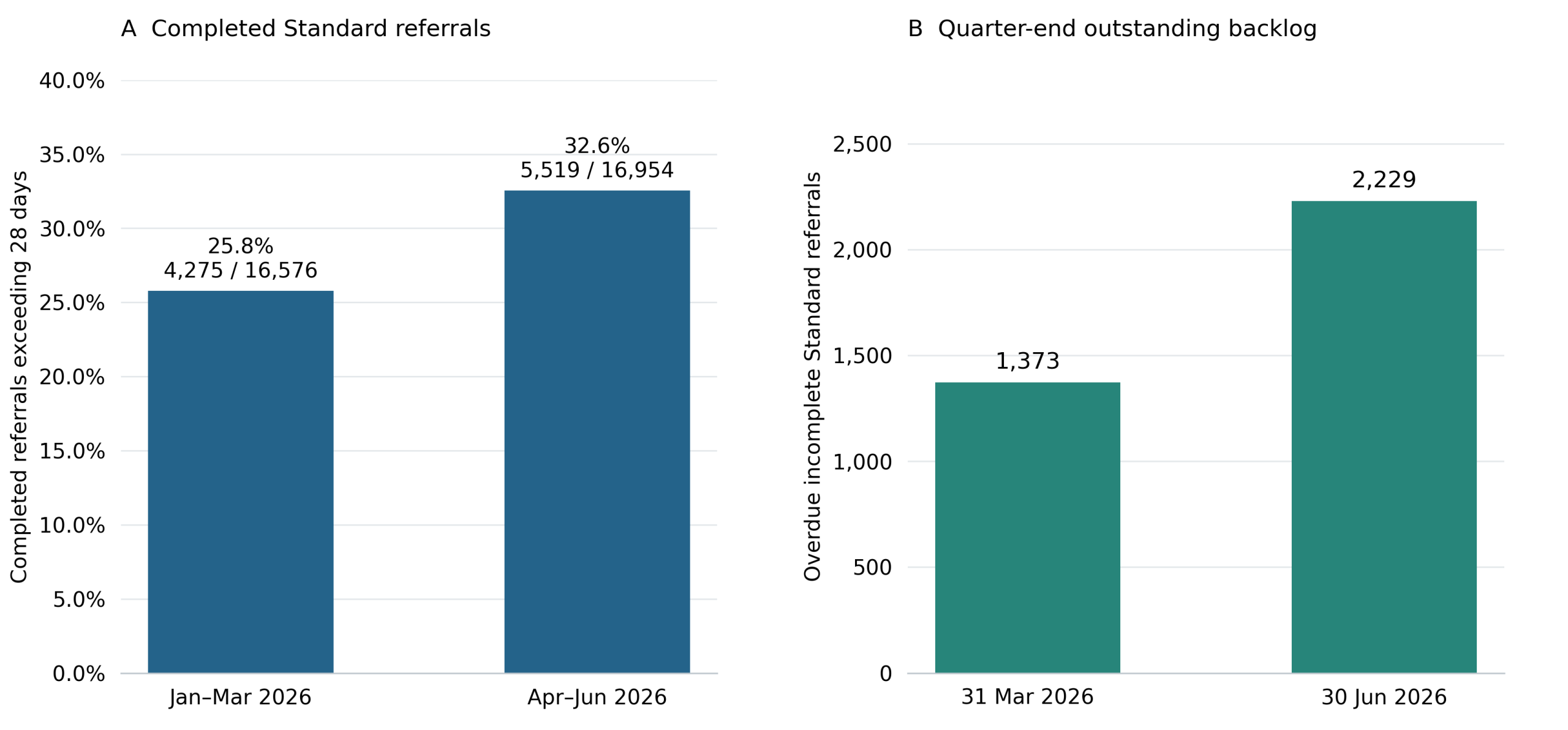
Source: NHS England (2026a, 2026b), Q4 2025/26 and Q1 2026/27; 1.3 In Quarter (completed referrals and completion within 28 days) and 1.1 Snapshot (overdue incomplete referrals), England E1. Percentages and changes are review calculations. Referral denominators include cases discounted before assessment. Backlog counts are separate snapshots and do not identify individual waiting times.
Recorded assessment outcomes differed across the selected periods and localities (Figure 2). England’s Standard assessment eligibility proportion was 20.8%, 16.7% and 17.7%; Cheshire and Merseyside’s was 25.5%, 19.9% and 16.7%. Warrington’s corresponding proportions were 28.3%, 16.0% and 9.2%, based on 13/46, 8/50 and 6/65 assessments. The earliest-to-latest difference was −3.1 percentage points nationally and −19.0 percentage points in Warrington, calculated from unrounded values. These are disparities in recorded outcomes, with small local denominators and no adjustment for differences in assessed needs or referral composition. (NHS England, 2024, 2026a, 2026b)
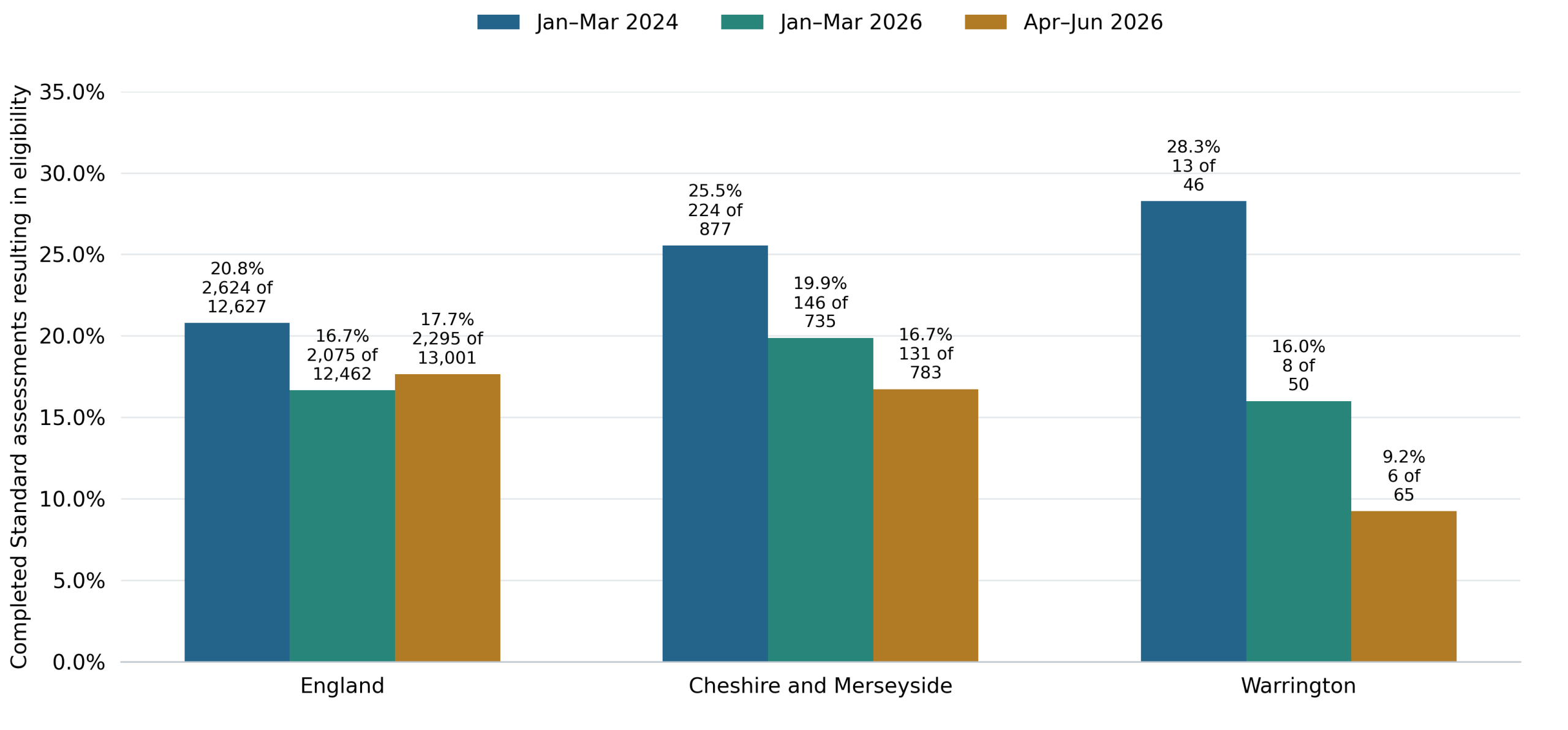
Source: NHS England (2024, 2026a, 2026b), Q4 2023/24, Q4 2025/26 and Q1 2026/27; 1.3 In Quarter, Standard assessments and newly eligible Standard cases. Organisation codes: E1 England, QYG Cheshire and Merseyside, 02E Warrington. Labels retain numerators and denominators. Locality selection is explained in Methods; nested populations must not be combined. These are selected quarters, not a continuous series.
The final included audit reports add local pathway outcomes without supplying national eligibility probabilities. Thirukkumaran et al. (2012) reported 41/42 Fast Track applications approved, 39/42 decisions within 48 hours and preferred place of care/death achieved for 28/42. Tan et al. (2014) reported a mean CHC assessment wait of 8.75 days, but no CHC subgroup denominator. Vardon, Giwa and Baylis (2017) reported Fast Track discharge time falling from 20 to 11 days within a multicomponent before/after project; subgroup sizes were absent. These are separate selected populations and measures, not comparable causal effects.
Turner et al. (2026) compared 81 referred patients with a highly selected non-referred group. Only 33 of 176 reviewed non-referred records remained after exclusions. The reported missed referral opportunities are important local observations, but retrospective prognostic classification and substantial exclusions constrain estimates of unmet eligibility. These findings cannot be used to estimate an individual’s likelihood of a funding award.
3.3 RQ2: Experiences and consequences
Information and participation were recurrent concerns in local and national experience reports. Respondents described limited prior awareness, difficulties obtaining updates and challenges explaining fluctuating or unfamiliar needs. Lambeth interviews also described trusted professionals, clear explanations and regular contact as helpful. These accounts indicate variation in how the process is delivered, rather than universally negative experience. They do not establish the population frequency of poor communication. (Healthwatch Enfield, 2020; Healthwatch Gateshead and Newcastle, 2018; Healthwatch Lambeth, 2023; Parkinson’s UK and Continuing Healthcare Alliance, 2016)
Eligibility did not always translate into workable care. PHSO investigations documented missing care plans, unsupported package reductions and additional charges in selected cases. Deaney and colleagues described three rural clinical cases in which appropriate care was difficult to secure after eligibility. One involved a person with Alzheimer’s disease and a distant placement. These are investigated or clinician-mediated implementation accounts, not representative estimates of unmet need or independently measured patient distress. (Deaney et al., 2024; Parliamentary and Health Service Ombudsman, 2020)
Fast Track evidence highlighted the limited time available. In the 2021 local referral cohort, 129 of 439 people died before discharge: 29.4% (review-calculated 95% interval 25.3–33.8%). Median survival overall was 15 days. The study does not establish that funding delay caused these deaths. (Morrison et al., 2023) In CareFFuL phase 2, 94 of 104 patients were discharged home: 90.4% (83.2–94.7%), with a median wait of one day. Most were supported through the rapid-response or social-care arrangements described by the project, so this is not a CHC-funded discharge rate. (Morrison et al., 2024)
The evidence reported financial exposure, uncertainty, repeated explanation and disruption to care, but methods and perspectives differed. Investigated failures have a different documentary basis from self-reported experience; clinician descriptions of family consequences are distinct from direct carer accounts. No pooled estimate of emotional burden, family expenditure or care disruption was justified. (Age UK, 2024; Deaney et al., 2024; Healthwatch Lambeth, 2023; Parkinson’s UK and Continuing Healthcare Alliance, 2016; Parliamentary and Health Service Ombudsman, 2020)
The final documentation and service reports reinforce the distinction between recorded process and experienced care. Stapleton et al. (2025) reported increasing care-plan completion among 68 Fast Track discharges, but incomplete documentation of holistic wishes. Hill et al. (2023) found improved GP instructions and anticipatory prescribing among 181 discharge summaries alongside poorer follow-up documentation; conflicting readmission wording was not interpreted as an improvement or deterioration. Neither study directly measured whether patients’ wishes were met.
Glasgow et al. (2023) combined 72 referral outcomes with 13 staff interviews describing paperwork, communication, recognition and staffing barriers. These professional explanations complement outcome reporting, although integration methods were incompletely described. Clayton (2025) described CHC staffing support for the motivating young adult in a four-person service; funding for every service user was not established. These reports remain distinct from adults’ own accounts of participation and consequences.
3.4 RQ3: Factors and explanations
Professional and institutional sources proposed awareness, condition knowledge, evidence gathering, interpretation of needs, commissioning and local relationships as influences on CHC practice. The Nuffield mixed methods report also described collaborative and holistic practice. These explanations are plausible and relevant to observed experiences, but the synthesis does not establish their independent effect on eligibility. Organisational accounts may reflect institutional responsibilities and interests. (Gainsbury et al., 2026; Hutchings et al., 2025; The King’s Fund, 2018; Wirral Council, 2018)
The final Fast Track study reported median survival of 18 days for approved applications and 25 days for deferred applications (p=0.0013). This is an unadjusted association; the groups also differed in age, and outcome categories overlap. It cannot establish that deferment prolonged or shortened survival. (Morrison et al., 2023) CareFFuL reported a historical mean wait of 6.3 days compared with 1.02 days in the project, a descriptive difference of −5.28 days. Equipment, communication, team arrangements, funding and site coverage changed together, preventing isolation of a funding-sequence effect. The project’s cost estimates remain modelled rather than realised cash savings. (Morrison et al., 2024)
Professional ethnography describes funding-panel difficulties, placement constraints and moral distress in one acute trust (Georgiadis, Corrigan and Speed, 2017). Adult-attributable Rotherham scrutiny evidence identifies panel and joint-working tensions alongside improvements (Rotherham Borough Council, 2012). Staff interviews in a Bristol Fast Track evaluation identify paperwork, communication, recognition and staffing barriers (Glasgow et al., 2023). These accounts explain experience and local practice without independently establishing decision error or causal effects.
Evidence about advocacy or representation did not support an adjusted estimate of their effect on decision outcomes. Local survey information on being told about appeal rights and on undertaking an appeal used different item denominators and did not measure appeal success. (Healthwatch Gateshead and Newcastle, 2018) The absence of linked person-level information restricted assessment of documentary and representational factors across complete journeys.
Dalingwater (2018) adds contrasting professional and selected testimonial perspectives. Its analysis of 40 published testimonials and interviews with managers from 31 of 130 invited teams described barriers, withdrawal, contested appeals and some reinstatement with retrospective funding. Managers generally defended practice and proposed differences in interpretation, reporting, joint funding and alternative services as explanations for variation. Selection, incomplete coding/reflexivity reporting and absent needs adjustment mean these are exploratory explanations rather than an estimate of unjustified refusal.
England-attributable testimony from the All Party Parliamentary Group on Parkinson’s (2013) and adult-attributable Rotherham scrutiny (Rotherham Borough Council, 2012) extend the historical evidence on participation, panel processes and inter-organisational working. Mixed-jurisdiction and inseparable child findings were excluded from extracted conclusions. Dowler (2014) supplies documentary evidence about retrospective liabilities and fiscal pressures, which does not itself establish a patient-level causal mechanism or unlawful rationing.
3.5 RQ4: Context, integration and missing perspectives
Numerical and experiential findings often complemented one another without proving a shared cause. Administrative timeliness measures identified delays in defined populations; local accounts described uncertainty and difficulty obtaining updates. Fast Track cohort findings showed short survival; the improvement project illustrated the feasibility of faster home discharge in a different period and selected pathway. These findings concern related processes but are not controlled comparisons or identical cohorts. (Healthwatch Lambeth, 2023; Morrison et al., 2023, 2024; NHS England, 2024, 2025, 2026a, 2026b; Palmer and Rolewicz, 2020)
Local variation was documented, while the Nuffield analysis found that age and deprivation explained some variation. Residual differences did not establish wrongful refusal. Financial reviews identified boundary tensions and conditional savings scenarios, but did not quantify individual effects of savings plans. Conflicting endpoints in Age UK material and rate/population labels in Worcestershire material were withheld from independent numerical comparisons. (Age UK, 2024; Gainsbury et al., 2026; Hutchings et al., 2025; Worcestershire County Council, 2025)
The selected administrative comparisons make these disparities visible at different pathway stages. In April–June 2026, 45.9% of completed Standard referrals in Cheshire and Merseyside exceeded 28 days, compared with 32.6% nationally; Warrington recorded 32.0%. Across the two consecutive 2026 quarters, local resolutions resulting in eligibility were 4/103 (3.9%) in Cheshire and Merseyside and 196/1,417 (13.8%) nationally. This is a comparison of recorded completed local resolutions, not unique individuals or NHS England Independent Review Panel outcomes. The contrast between assessment, referral completion and challenge outcomes reinforces the need for stage-specific interpretation. (NHS England, 2026a, 2026b)
Additional audits describe CHC assessment waits, Fast Track discharge timing, documentation and possible missed referrals (Tan et al., 2014; Vardon, Giwa and Baylis, 2017; Hill et al., 2023; Stapleton et al., 2025; Turner et al., 2026). Their incomplete denominators, retrospective classification and uncontrolled changes limit comparisons. Small service-development and financial-investigation accounts add implementation and retrospective-claim context (Clayton, 2025; Dowler, 2014). England-attributable inquiry testimony adds participation and challenge accounts, while mixed UK submissions prevent unqualified aggregation (All Party Parliamentary Group on Parkinson’s, 2013). Appendix K retains the source-level limits.
Direct accounts from people with dementia were limited. Dementia-specific material largely consisted of selected family narratives, investigator accounts and clinician-mediated cases. Family proxy descriptions of a recipient’s experience were distinguished from carers describing their own burden. Public involvement in research design was not counted as an analysed patient-experience dataset. Missing direct voice constrains interpretation of dignity, preferences and participation without negating the value of carer evidence. (Age UK, 2024; Deaney et al., 2024; Healthwatch Enfield, 2020; Healthwatch Lambeth, 2023; Hutchings et al., 2025; Parkinson’s UK and Continuing Healthcare Alliance, 2016; Parliamentary and Health Service Ombudsman, 2020)
4. Discussion
4.1 Principal interpretation
The synthesis identifies a distinction between a decision outcome and the experience and consequences of the wider process. Awards, refusals, changed decisions and remedies require stage-specific definitions. Appropriate care, understandable communication and meaningful participation are additional outcomes. An eligibility measure alone cannot show whether people received suitable support, while a difficult experience does not determine whether an eligibility decision was clinically or legally correct.
The strongest integrated interpretation is that CHC must be examined as a sequence of linked but distinguishable processes. Timing has different significance in Standard assessment and rapidly changing end-of-life care. Organisational relationships may help or hinder coordination, while provider availability affects whether funding can become care. Across these processes, positive examples of support and collaboration qualify accounts of difficulty. The review therefore supports attention to delivery and implementation alongside eligibility, without identifying a single universal explanation for problems.
The administrative figures add a population-level dimension to this interpretation. Recorded geographical disparities in assessment eligibility and referral timeliness, together with rising national overdue activity, show that access cannot be adequately described by an eligibility outcome alone. Read alongside accounts of unclear information, repeated explanation and difficulty obtaining updates, these findings connect variation in the pathway with the review’s themes of participation, timeliness and uncertainty. They are complementary evidence: administrative records describe the distribution of outcomes and unresolved work, while experiential sources describe what navigating those processes can involve. The datasets do not link the same people, so the synthesis does not attribute a measured family consequence to a particular aggregate disparity. (Healthwatch Enfield, 2020; Healthwatch Gateshead and Newcastle, 2018; Healthwatch Lambeth, 2023; Hutchings et al., 2025; NHS England, 2024, 2025, 2026a, 2026b; Parkinson’s UK and Continuing Healthcare Alliance, 2016)
These comparisons have descriptive value without establishing causation. They identify where recorded access and timeliness differ, and provide a basis for asking whether people with comparable needs encounter comparable processes and support. The review distinguishes disparity, meaning an observed difference, from inequity, which would require evidence that the difference is unjust or avoidable. The figures establish the former; explaining the latter would require better information on needs, referral pathways, local practice and people’s experiences. Appendix J makes the numerical-to-experiential links explicit and identifies where evidence remains missing. (Hutchings et al., 2025; NHS England, 2024, 2025, 2026a, 2026b)
Uncertainty offers a cross-cutting interpretation of these findings. Difficulties understanding requirements or obtaining updates, waiting for decisions and securing care after eligibility can make the pathway itself part of the experience of illness and care. Taking the pathway as the unit of experience directs attention to how encounters connect over time and what remains unresolved between them, while acknowledging that the retained evidence seldom follows complete individual journeys. Clear explanations, regular contact and trusted professional support may help people navigate this uncertainty, as positive local accounts illustrate. This interpretation connects information and participation, timeliness, care continuity and challenge; it is not a separately measured outcome or a quantified national burden. Explicit accounts of uncertainty remain distinguishable from the review’s inference across related findings. (Deaney et al., 2024; Healthwatch Enfield, 2020; Healthwatch Gateshead and Newcastle, 2018; Healthwatch Lambeth, 2023; Parkinson’s UK and Continuing Healthcare Alliance, 2016; Parliamentary and Health Service Ombudsman, 2020)
The updated sensitivity assessment separates persistence of a theme from the breadth and credibility of its support. Removing complaints loses investigated remedies; removing weakly described surveys loses much reported frequency and breadth; removing abstract-only reports markedly reduces local service illustrations. Full Fast Track papers, administrative outcomes, interviews and professional research preserve some interpretations, but do not establish representativeness or causation. Excluding financial testimony weakens fiscal explanations without proving or disproving rationing. Excluding selected clinical cases narrows evidence about the gap between awards and workable care. Appendix N records source-specific consequences for each theme.
4.2 Structural tensions and their consequences
The findings raise a structural question: how can a nationally defined, needs-based funding arrangement operate consistently when assessment, commissioning and financial responsibility are organised locally across separately funded health and social care systems? The author’s earlier public-facing commentary prompted this discussion, but is not treated as an independent source or additional study. The interpretation below draws on the retained reports and distinguishes documented problems from proposed explanations.
Hutchings et al. (2025) describe variation in access, spending and practice, financial cliff edges and tensions between health and social care. Age and deprivation explain some geographical differences, leaving other variation requiring investigation. This supports examination of local processes; it does not establish that local interpretation alone determines outcomes or that every refusal is unfair. The concern is whether people with comparable needs can obtain comparable assessment, participation and workable care.
Financial pressures are relevant, but rising expenditure and restricted access can coexist. Nuffield’s analysis found net CHC expenditure increased by 17.1% in real terms between 2017/18 and 2022/23; its expenditure measure excluded personal health budgets (Hutchings et al., 2025). Expenditure is therefore not a direct measure of access or adequacy. The Public Accounts Committee warned about the proposed £855 million savings in CHC and NHS-funded nursing care against forecast spending growth by 2020/21, questioning how these could be achieved without threatening eligibility or available care packages. This was a warning about risks, not evidence that every efficiency measure reduced entitlement (House of Commons Committee of Public Accounts, 2018).
The consequences of procedural failure can be substantial even where eligibility is recognised. PHSO documented failures in care planning that left people paying for care themselves, including one case involving approximately £250,000 in agreed reimbursement. Such cases demonstrate potential harm and the importance of implementing funded care; they do not estimate its national frequency or establish that all CHC decisions are unlawful (Parliamentary and Health Service Ombudsman, 2020).
Governance concerns should likewise be described precisely. The PAC criticised inadequate action on delays and variation, while Nuffield recommended clearer governance and accountability. This supports scrutiny of oversight arrangements rather than a claim that no oversight or challenge mechanisms exist. Changing Standard and Fast Track activity also requires separate analysis: a larger Fast Track share does not demonstrate that Standard eligibility has been redefined as terminal illness (House of Commons Committee of Public Accounts, 2018; Hutchings et al., 2025).
Historical gaps in retrospective guidance must be distinguished from current policy. PHSO’s 2020 report identified uncertainty about previously unassessed care after April 2012. DHSC and NHS England subsequently published guidance on 14 December 2023 addressing requests for these periods. Its publication corrects the historical absence; it does not establish consistent local implementation. This guidance is an additional policy-context reference, not a new contributing empirical source (Parliamentary and Health Service Ombudsman, 2020; Department of Health and Social Care and NHS England, 2023).
Taken together, these findings support a critical interpretation of the boundary between health and social care. Unclear responsibilities, variable processes and difficulties converting funding into care can place additional work and uncertainty on people already facing serious illness. Describing these tensions is more defensible than treating inherent failure, unlawful rationing or moral failure as measured findings. The ethical implication is that timely, understandable and participatory access to appropriate care should be evaluated alongside the formal funding decision.
4.3 Implications for practice and policy
The findings support clearer stage-specific communication and documentation of what has been decided, what remains unresolved and what happens next. Monitoring should distinguish assessment completion, decision, care implementation and the implementation of review recommendations. Linking these outcomes would allow a more meaningful account of access than stock or conversion alone. These are implications drawn from the integrated evidence; their effectiveness has not been tested by this review.
Fast Track findings support attention to referral and care arrangements when time is short, but do not demonstrate that any one funding model should be adopted nationally. Local improvement results require evaluation across different populations and commissioning environments, with clearer ascertainment, concurrent comparators where feasible and explicit patient and family outcomes. Financial savings claims should separate released capacity, avoided costs and realised expenditure reductions.
4.4 Research priorities
The limited detailed primary research is consequential because administrative indicators cannot show the cumulative work, distress or care consequences of an individual journey. Original grey literature helps address this gap, but selected samples and incompletely described methods restrict what can be inferred. The evidence therefore supports a targeted research agenda rather than a claim that no primary CHC research exists. (Healthwatch Enfield, 2020; Healthwatch Gateshead and Newcastle, 2018; Healthwatch Lambeth, 2023; Hutchings et al., 2025; Parkinson’s UK and Continuing Healthcare Alliance, 2016)
Future studies should follow people across referral, assessment, decision, implementation and challenge, preserving repeated decisions and unresolved outcomes. They should describe clinical needs, representation, documentary evidence and organisational context, and distinguish recommendations from actual funding or care. Comparative analyses need appropriate adjustment and a justified unit of analysis. Direct patient experience, including accessible approaches for people with dementia, should complement family and professional perspectives. Research should also seek straightforward and positive journeys rather than relying mainly on disputed cases.
4.5 Strengths, limitations and reflexivity
The review brings together evidence types that describe different parts of the CHC journey, preserves source locators and denominators, links repeated material and retains positive and contrary accounts. Appraisal and narrative sensitivity checks make the dependence of interpretations on weaker or selected evidence visible. However, these safeguards do not establish completeness or eliminate bias.
The review used one human reviewer with AI assistance and no independent duplicate screening, extraction or appraisal. This increases vulnerability to error and selective interpretation. The reviewer’s clinical and family experience of CHC informed the question and may shape attention to difficulties. Personal family records are not included as primary evidence. Reflexive consideration of assumptions and retention of supportive practice are relevant safeguards, but do not replace independent review. AI contributions and human checks should be disclosed accurately without claiming verification that did not occur.
Primary-source limitations include selection, incompletely described analysis, uncertain nonresponse, outcome classification issues, short local series and uncontrolled comparisons. Some sources share underlying material, and administrative definitions differ across periods. Missing studies or results were not formally assessed. Record dispositions have been reconciled, but complete executed search histories, precise retrieval/full-text assessment totals and an independent-study count remain unverified. Three grey inventory entries lack verified identities and contribute no findings. These reporting limitations preclude a final claim of comprehensive systematic coverage. No formal certainty grade, pooled national outcome or causal estimate was produced.
The figures use selected quarters and unadjusted aggregate outcomes. Locality selection reflects the reviewer’s context and cannot represent all local systems. Population needs, referral composition, seasonality, organisational geography and reporting definitions may affect comparisons. Small local denominators and nested national/local populations limit interpretation. Historical snapshots are presented separately in Appendix I, preserving their contextual status.
5. Conclusion
Available evidence documents variation in CHC processes, selected decision changes, local timing and discharge outcomes, and experiences of both difficulty and helpful support. It shows why obtaining a decision and receiving appropriate care should be evaluated separately. The evidence does not establish national decision-error rates or causal effects of funding arrangements. A fuller account requires linked stage-specific outcomes and greater representation of adults’ own experiences, particularly those of people with dementia.
Declarations
Registration and protocol: the review was not registered. Protocol version 5 and dated amendments accompany the accompanying evidence and audit package. Funding: self-funded, with no external funding or sponsor. Contributions: One person was the sole human reviewer; ChatGPT assisted with screening support, extraction, appraisal, calculations, synthesis and drafting. AI assistance was not independent review.
Lived-experience involvement and competing interests: the author is an Advanced Clinical Practitioner and a family carer involved in CHC processes. This experience informed the question, pathway framing and interpretation and is a relevant competing perspective. Family case records were excluded from the core evidence; no independent patient/carer advisory group was involved. No new participant data were collected. Data availability: extraction, appraisal, transformation, sensitivity, selection and calculation materials accompany the accompanying evidence and audit package; no public repository deposit is claimed.
References
- Age UK (2024) Continuing to care: Older people let down by NHS Continuing Healthcare. London: Age UK. Available at: https://www.ageuk.org.uk/siteassets/documents/reports-and-publications/consultation-responses-and-submissions/health–wellbeing/continuing-to-care—nhs-continuing-healthcare-report.pdf (Accessed: 6 October 2026).
- All Party Parliamentary Group on Parkinson’s (2013) Failing to care: NHS continuing care in England. London: Parkinson’s UK. Report consulted as supplied PDF.
- Bristol, North Somerset and South Gloucestershire Integrated Care Board (2024) Continuing Healthcare applications: Freedom of Information response FOI.ICB-2324/382. 2 February. Available at: https://bnssghealthiertogether.org.uk/wp-content/uploads/2024/02/FOI.ICB-2324_382-CHC-Applications-Final-Response.pdf (Accessed: 6 October 2026).
- Clayton, J. (2025) Transition – to What? It Is a Whole New Service. BMJ Supportive and Palliative Care. Available at: https://doi.org/10.1136/spcare-2025-HUK.169 (Source checked in retained records/retrieval audit: 10 October 2026).
- Crowe, E. V., Dhallu, S., Crabtree, S., Waterhouse, E. (2016) Use of diversional beds in Walsall for patients thought to be in the last four weeks of life. Published conference abstract. Available at: https://journals.sagepub.com/doi/pdf/10.1177/0269216316631462 (Access date recorded: 5 October 2026; source assessed: 10 October 2026).
- Dale, S. (2022) Creating Equality in End-of-Life Domiciliary Care at Home across Cheshire. Published conference abstract. Available at: https://doi.org/10.1136/spcare-2022-HUNC.35 (Access date recorded: 5 October 2026; source assessed: 10 October 2026).
- Dalingwater, L. (2018) Inequity in Supply of Health Care? The Case of Continuing Health Care in England. The International Journal of Health, Wellness, and Society, 8(4), pp. 43–60. Available at: https://doi.org/10.18848/2156-8960/CGP/v08i04/43-60 (Access date recorded: 5 October 2026; source assessed: 10 October 2026).
- Deaney, C., Hemingway, E., Reesby, D. and Scott, V. (2024) ‘Evaluating the care gaps and inequalities arising in Continuing Healthcare (CHC) delivery in rural areas’, Journal of Primary Care & Community Health, 15, article 21501319241305968. Available at: https://doi.org/10.1177/21501319241305968 (Accessed: 6 October 2026).
- Department of Health (2013) NHS continuing care figures for quarter 4 of 2012–13. Data workbook covering 2009/10 to 2012/13. London: Department of Health. Available at: https://www.gov.uk/government/publications/nhs-continuing-healthcare (Accessed: 6 October 2026).
- Department of Health and Social Care (2022a) Fast Track Pathway Tool for NHS Continuing Healthcare: guidance. Revised edition. London: Department of Health and Social Care. Available at: https://www.gov.uk/government/publications/nhs-continuing-healthcare-fast-track-pathway-tool (Accessed: 6 October 2026).
- Department of Health and Social Care (2022b) National framework for NHS continuing healthcare and NHS-funded nursing care. July 2022 revised edition, corrected July 2023. London: Department of Health and Social Care. Available at: https://www.gov.uk/government/publications/national-framework-for-nhs-continuing-healthcare-and-nhs-funded-nursing-care (Accessed: 6 October 2026).
- Department of Health and Social Care and NHS England (2023) Continuing healthcare previously unassessed periods of care. Published 14 December 2023. Available at: https://www.gov.uk/government/publications/continuing-healthcare-previously-unassessed-periods-of-care (Accessed: 10 October 2026).
- Dowler, C. (2014) Financially challenged areas among biggest losers from care claims clawback. HSJ.co.uk. Available at: https://www.proquest.com/docview/1527715780 (Source checked in retained records/retrieval audit: 10 October 2026).
- Gainsbury, S., Davies, M., Dodsworth, E., Vassiliou, S., Stein, T. and Watson, G. (2026) Review of Staffordshire and Stoke-on-Trent Integrated Care Board’s 2025/26 savings plans. Research report. London: Nuffield Trust. Available at: https://www.nuffieldtrust.org.uk/research/review-of-staffordshire-and-stoke-on-trent-integrated-care-board-s-202526-savings-plans (Accessed: 6 October 2026).
- Georgiadis, A., Corrigan, O. and Speed, E. (2017) Frontline Healthcare Staffs’ Experience of Organizing Complex Hospital Discharges: An Ethnographic Study. Ethics & Behavior. Available at: https://repository.essex.ac.uk/17091/1/Frontline%20Healthcare%20Staffs%20Experience%20of%20Organising%20Complex%20Hospital%20Discharges%20An%20Ethnographic%20Study.pdf (Source checked in retained records/retrieval audit: 10 October 2026).
- Glasgow, C., Harrison, R., Jones, C. and Chamberlain, C. (2023) Putting the ‘Fast’ Back in ‘Fast Track’: A Mixedmethods Service Evaluation. BMJ Supportive and Palliative Care. Available at: https://doi.org/10.1136/spcare-2023-PCC.121 (Source checked in retained records/retrieval audit: 10 October 2026).
- Healthwatch Enfield (2020) Listening to people’s experiences of using NHS continuing healthcare. Research report. June. Available at: https://nds.healthwatch.co.uk/sites/default/files/reports_library/20200603_CHCReport-Final.pdf (Accessed: 6 October 2026).
- Healthwatch Gateshead and Newcastle (2018) NHS continuing healthcare in Gateshead and Newcastle. Research report. Available at: https://nds.healthwatch.co.uk/reports-library/nhs-continuing-healthcare-gateshead-and-newcastle-0 (Accessed: 6 October 2026).
- Healthwatch Lambeth (2023) Experiences of applying for Continuing Healthcare in Lambeth. Report published online 12 December 2023; interviews conducted in 2022. Available at: https://nds.healthwatch.co.uk/reports-library/continuing-healthcare (Accessed: 6 October 2026).
- Hill, A., Barber, L., Strain, R. and England, R. (2023) Transferring the Care of Patients Who Are Approaching the End of Their Lives – a Re-Audit of Hospital Discharge Summaries. BMJ Supportive and Palliative Care. Available at: https://doi.org/10.1136/spcare-2023-PCC.112 (Source checked in retained records/retrieval audit: 10 October 2026).
- Hong, Q.N., Pluye, P., Fàbregues, S., Bartlett, G., Boardman, F., Cargo, M., Dagenais, P., Gagnon, M.-P., Griffiths, F., Nicolau, B., O’Cathain, A., Rousseau, M.-C. and Vedel, I. (2018) Mixed Methods Appraisal Tool (MMAT), version 2018. User guide. Available at: https://mixedmethodsappraisaltoolpublic.pbworks.com/w/page/127425845/Download%20the%20MMAT (Accessed: 6 October 2026).
- House of Commons Committee of Public Accounts (2018) NHS continuing healthcare funding. Thirteenth Report of Session 2017–19, HC 455. London: House of Commons. Available at: https://publications.parliament.uk/pa/cm201719/cmselect/cmpubacc/455/455.pdf (Accessed: 6 October 2026).
- HSJ.co.uk (2013a) NHS Manchester receives 300 backdated continuing care claims. Trade-press report, 24 January. Available at: https://www.proquest.com/docview/1272366037 (Access date recorded: 5 October 2026; source assessed: 10 October 2026).
- HSJ.co.uk (2013b) NHS Tameside and Glossop faces estimated £1m cost for retrospective continuing care claims. Trade-press report, 24 January. Available at: https://www.proquest.com/docview/1272366034 (Access date recorded: 5 October 2026; source assessed: 10 October 2026).
- Hutchings, R., Dodsworth, E., Curry, N., Best, R. and Davies, M. (2025) All or nothing? Access and variation in NHS continuing health care. Research report. London: Nuffield Trust. Available at: https://www.nuffieldtrust.org.uk/sites/default/files/2025-09/Nuffield%20Trust%20-%20Continuing%20health%20care_WEB.pdf (Accessed: 6 October 2026).
- JBI (n.d.) 8.2 Concepts and considerations for mixed methods systematic reviews. In: JBI Manual for Evidence Synthesis. Online manual. Available at: https://jbi-global-wiki.refined.site/space/MANUAL/355829239/8.2%20Concepts%20and%20considerations%20for%20mixed%20methods%20systematic%20reviews (Accessed: 6 October 2026).
- McKenny, L., Davison, K. (2023) Providing Hospice Fast Track Care in Patients’ Own Homes. Published conference abstract. Available at: https://spcare.bmj.com/content/13/Suppl_5/A28.1 (Access date recorded: 5 October 2026; source assessed: 10 October 2026).
- Moore, J., Tritton, J., Richardson, F. (2019) A Collaborative Project to Provide a Rapid Personalised Care Service (Rpcs) for Patients. Published conference abstract. Available at: https://spcare.bmj.com/content/bmjspcare/9/Suppl_4/A87.2.full.pdf (Access date recorded: 5 October 2026; source assessed: 10 October 2026).
- Moreland, J. (2019) Fast Track Improvement Project: Six Month Report (Sept 2018 – March 2019). Published conference abstract. Available at: https://spcare.bmj.com/content/9/Suppl_4/A86.3 (Access date recorded: 5 October 2026; source assessed: 10 October 2026).
- Morrison, J., Choudhary, C., Beazley, R., Richards, J. and Davis, C. (2023) ‘Observational study of survival outcomes of people referred for ‘fast-track’ end-of-life care funding in a district general hospital: too little too late?’, BMJ Open Quality, 12(2), e002279. Available at: https://doi.org/10.1136/bmjoq-2023-002279 (Accessed: 6 October 2026).
- Morrison, J., Robinson, F., Witney, A., Greene, H., Marks, C. and Davis, C. (2024) ‘Care First-Fund Later (CareFFuL): an end-of-life home care quality improvement project’, BMJ Open Quality, 13(2), e002790. Available at: https://doi.org/10.1136/bmjoq-2024-002790 (Accessed: 6 October 2026).
- National Audit Office (2017) Investigation into NHS continuing healthcare funding. HC 239, Session 2017–19. London: National Audit Office. Corrected January 2018. Available at: https://www.nao.org.uk/reports/nhs-continuing-healthcare-investigation/ (Accessed: 6 October 2026).
- NHS Digital (2017) NHS Continuing Healthcare Activity, England, Quarter 3, 2016–17. Data tables. Published 20 April; wording corrected 25 April. Available at: https://digital.nhs.uk/data-and-information/publications/statistical/nhs-continuing-healthcare-activity (Accessed: 6 October 2026).
- NHS England (2024) NHS Continuing Healthcare and NHS-funded Nursing Care: quarterly data, Q4 2023/24. Data workbook. Available at: https://www.england.nhs.uk/statistics/statistical-work-areas/nhs-chc-fnc/ (Accessed: 6 October 2026).
- NHS England (2025) NHS Continuing Healthcare and NHS-funded Nursing Care: quarterly data, Q4 2024/25. Data workbook. Revised workbook. Available at: https://www.england.nhs.uk/statistics/statistical-work-areas/nhs-chc-fnc/ (Accessed: 6 October 2026).
- NHS England (2026a) NHS Continuing Healthcare and NHS-funded Nursing Care: quarterly data, Q4 2025/26. Data workbook. Management information. Available at: https://www.england.nhs.uk/statistics/statistical-work-areas/nhs-chc-fnc/ (Accessed: 6 October 2026).
- NHS England (2026b) NHS Continuing Healthcare and NHS-funded Nursing Care: quarterly data, Q1 2026/27. Data workbook. Management information. Available at: https://www.england.nhs.uk/statistics/statistical-work-areas/nhs-chc-fnc/ (Accessed: 6 October 2026).
- NIST/SEMATECH (n.d.) 7.2.4.1. Confidence intervals. In: e-Handbook of Statistical Methods. National Institute of Standards and Technology. Available at: https://www.itl.nist.gov/div898/handbook/prc/section2/prc241.htm (Accessed: 6 October 2026).
- Page, M.J., McKenzie, J.E., Bossuyt, P.M., Boutron, I., Hoffmann, T.C., Mulrow, C.D., Shamseer, L., Tetzlaff, J.M., Akl, E.A., Brennan, S.E., Chou, R., Glanville, J., Grimshaw, J.M., Hróbjartsson, A., Lalu, M.M., Li, T., Loder, E.W., Mayo-Wilson, E., McDonald, S., McGuinness, L.A., Stewart, L.A., Thomas, J., Tricco, A.C., Welch, V.A., Whiting, P. and Moher, D. (2021) ‘The PRISMA 2020 statement: an updated guideline for reporting systematic reviews’, BMJ, 372, n71. Available at: https://doi.org/10.1136/bmj.n71 (Accessed: 6 October 2026).
- Palmer, W. and Rolewicz, L. (2020) Rural, remote and at risk: Why rural health services face a steep climb to recovery from Covid-19. Research report. London: Nuffield Trust. Available at: https://www.nuffieldtrust.org.uk/research/rural-remote-and-at-risk (Accessed: 6 October 2026).
- Parkinson, T., McGeown, J. (2017) Enhancing Discharge Processes. Published conference abstract. Available at: https://doi.org/10.1136/bmjspcare-2017-hospice.187 (Access date recorded: 5 October 2026; source assessed: 10 October 2026).
- Parkinson’s UK and Continuing Healthcare Alliance (2016) Continuing to care: Is NHS continuing healthcare supporting the people who need it in England?. London: Parkinson’s UK. Available at: https://www.mndassociation.org/sites/default/files/2022-12/continuing-to-care-report.pdf (Accessed: 6 October 2026).
- Parliamentary and Health Service Ombudsman (2020) Continuing Healthcare: Getting it right first time. HC 872. London: Parliamentary and Health Service Ombudsman. Available at: https://www.ombudsman.org.uk/sites/default/files/Continuing_Healthcare_Getting_it_right_first_time.pdf (Accessed: 6 October 2026).
- Rethlefsen, M.L., Kirtley, S., Waffenschmidt, S., Ayala, A.P., Moher, D., Page, M.J., Koffel, J.B. and PRISMA-S Group (2021) ‘PRISMA-S: an extension to the PRISMA Statement for Reporting Literature Searches in Systematic Reviews’, Systematic Reviews, 10, article 39. Available at: https://doi.org/10.1186/s13643-020-01542-z (Accessed: 6 October 2026).
- Rotherham Borough Council (2012) Scrutiny review of Continuing Health Care. Rotherham: Rotherham Borough Council. Report consulted as supplied PDF.
- Saunsbury, E., Maggs, D. (2021) End of life care in patients with cirrhosis: A district general hospital perspective. Published conference abstract. Available at: https://doi.org/10.1136/gutjnl-2021-BASL.19 (Access date recorded: 5 October 2026; source assessed: 10 October 2026).
- Scholes, C. and Allan, R. (2012) Do patients referred to specialist palliative care (SPC) die where they prefer? A network-wide audit. Published conference abstract. Available at: https://doi.org/10.1136/bmjspcare-2012-000196.230 (Access date recorded: 5 October 2026; source assessed: 10 October 2026).
- Stapleton, L., Anderson, E., Eason, R. and Collis, E. (2025) Improving Use of Electronic Palliative Care Coordination Systems for Patients Discharged from an Acute Hospital Trust for End-of-Life Care. BMJ Supportive and Palliative Care. Available at: https://doi.org/10.1136/spcare-2025-PCC.78 (Source checked in retained records/retrieval audit: 10 October 2026).
- Tan, M.Z., Mackett, A., Ratcliff, C. and Niruban, A. (2014) 38 ANALYSIS OF TIMELINES FROM ‘MEDICALLY FIT’ TO DISCHARGE IN OLDER PATIENTS IN THE NORFOLK AND NORWICH UNIVERSITY HOSPITAL. Age & Ageing. Available at: https://academic.oup.com/ageing/article-abstract/43/suppl_2/ii9/28239 (Source checked in retained records/retrieval audit: 10 October 2026).
- The King’s Fund (2018) How is the NHS performing? March 2018 quarterly monitoring report. London: The King’s Fund. Available at: https://www.kingsfund.org.uk/insight-and-analysis/reports/how-nhs-performing-march-2018 (Accessed: 6 October 2026).
- Thirukkumaran, T., Subramaniam, S., de Nogla, S., Cawley, D. and Fisher, S. (2012) Audit on NHS fast tract applications: prognostic prediction & preferred place of care/death. BMJ Supportive & Palliative Care, suppl. 1. Available at: https://doi.org/10.1136/bmjspcare-2012-000196.269 (Source checked in retained records/retrieval audit: 10 October 2026).
- Thomson, M., McGaughey, S., Platt, T., Gaffney, R. (2019) ‘Please, I Want to Go Home’ – Creating a Homecare Team to Expedite Discharge Home from Hospital at the End of Life. Published conference abstract. Available at: https://spcare.bmj.com/content/bmjspcare/9/Suppl_1/A30.3.full.pdf (Access date recorded: 5 October 2026; source assessed: 10 October 2026).
- Turner, R., Tsang, K., Woodman, C., Blackburn, I., Chamberlain, C. and Wilson, E. (2026) PP-57 Missed opportunities for NHS continuing health care fast track funding referrals. BMJ Supportive & Palliative Care. Available at: https://doi.org/10.1136/spcare-2026-MCRC.68 (Source checked in retained records/retrieval audit: 10 October 2026).
- Vardon, E., Giwa, A. and Baylis, D. (2017) Delayed transfers of care: Aiming to unblock the bed crisis. Age and Ageing. Conference: British Geriatrics Society Communications to the Spring Meeting. Available at: https://academic.oup.com/ageing/article/46/suppl_2/ii1/3950220 (Source checked in retained records/retrieval audit: 10 October 2026).
- Wilcock, J. (2012) Independent living following ABI-myth or reality?. Published conference abstract. Available at: https://doi.org/10.3109/02699052.2012.660091 (Access date recorded: 5 October 2026; source assessed: 10 October 2026).
- Wirral Council (2018) Continuing Healthcare scrutiny review. Adult Care and Health Overview and Scrutiny Committee Task and Finish Group. Review completed May; presented June. Available at: https://wirral.moderngov.co.uk/documents/s50050709/Enc.%201%20for%20Continuing%20HealthCare%20CHC%20Scrutiny%20Review.pdf (Accessed: 6 October 2026).
- Worcestershire County Council (2025) Overview of Continuing Healthcare (CHC). Adult Care and Well-being Overview and Scrutiny Panel, 29 September, item 6. Available at: https://worcestershire.moderngov.co.uk/documents/s58400/02%20Item%206%20Overview%20of%20CHC.pdf (Accessed: 6 October 2026).
Appendix G. Analytical themes and source contributions
G.1 Analytical theme definitions
These provisional themes organise the convergent integrated synthesis. They are interpretive outputs, not the prespecified CHC journey stages or replacements for RQ1–RQ4. Theme membership does not imply uniformly negative findings. Theme 7 also provides a cross-cutting perspective check.
Theme |
Definition and scope |
Research questions |
|---|---|---|
T1 Understanding and participating in the CHC process |
How information, professional support, communication and opportunities to contribute shape understanding and involvement. Includes helpful support, uncertainty and difficulties presenting needs. |
RQ2, RQ3 |
T2 Timeliness in relation to care needs |
How referral, assessment, decision and implementation timing relates to changing needs and time available. Standard and Fast Track remain separate; delay is not assumed to cause harm. |
RQ2, RQ3, RQ4 |
T3 Variation in access and decision outcomes |
Differences across localities, periods and populations, with attention to needs, referral patterns and organisational practice. Variation alone does not establish unfairness or error. |
RQ1, RQ3, RQ4 |
T4 Translating eligibility into appropriate care |
Whether eligibility leads to a timely workable package meeting needs and preferences. Provider availability, placement and continuity are distinct from funding approval. |
RQ1, RQ2, RQ3 |
T5 Negotiating the health and social care boundary |
How responsibilities, funding, relationships and resource pressures shape processes. Distinguishes observed consequences from institutional explanations and projections. |
RQ2, RQ3, RQ4 |
T6 Challenging decisions and securing remedies |
Local resolution, independent review, retrospective assessment and complaints: participation, changes and unresolved outcomes. Recommendation, award and payment remain distinct. |
RQ1, RQ2, RQ3 |
T7 Whose experiences and needs are represented? |
Differences between direct adult accounts, family proxy, carer own experience, professionals, investigators and administrative records. Includes missing direct dementia voice. |
RQ2, RQ4 |
G.2 Study-to-theme contribution matrix
C — extracted contribution X — context only – — no mapped contribution
The revised display contains 46 mapped source entries: 42 core entries, two supporting documentary entries and GL17–GL18 as historical context. Three companions have no independent row, and four database/grey aliases are counted once. C = contributes bounded extracted findings; X = context only; – = no mapped contribution. These are source-entry counts, not independent-study totals. Relevance does not imply quality or certainty; repeated findings are counted once.
Colours indicate contribution status only; they do not indicate methodological quality, risk of bias or certainty.
Source |
T1 |
T2 |
T3 |
T4 |
T5 |
T6 |
T7 |
|---|---|---|---|---|---|---|---|
GL01 Continuing Healthcare Getting it right first time |
C |
– |
– |
C |
– |
C |
C |
GL02 Continuing to care Is NHS continuing healthcare supporting the people who need it in England |
C |
C |
– |
C |
– |
– |
C |
GL03 Continuing to care Older people let down by NHS Continuing Healthcare |
– |
– |
– |
C |
– |
– |
C |
GL04 All or nothing Access and variation in NHS continuing health care |
C |
C |
C |
– |
C |
– |
C |
GL05 Experiences of applying for Continuing Healthcare in Lambeth |
C |
C |
– |
C |
– |
– |
C |
GL06 NHS continuing healthcare in Gateshead and Newcastle |
C |
– |
– |
– |
– |
C |
– |
GL07 Listening to people’s experiences of using NHS continuing healthcare |
C |
– |
– |
C |
– |
– |
C |
GL08 Investigation into NHS continuing healthcare funding |
– |
– |
C |
– |
– |
C |
– |
GL09 NHS continuing healthcare funding |
– |
– |
C |
– |
– |
– |
– |
GL10 Continuing HealthCare scrutiny review Wirral |
– |
– |
– |
– |
C |
– |
– |
GL11 Overview of Continuing Healthcare Worcestershire |
– |
– |
– |
– |
C |
– |
– |
GL12 Continuing Healthcare applications FOI response |
C |
– |
– |
– |
– |
– |
– |
GL13 NHS quarterly monitoring report March 2018 |
– |
– |
– |
– |
C |
– |
– |
GL14 Rural remote and at risk Why rural health services face a steep climb to recovery from Covid 19 |
– |
C |
– |
– |
– |
– |
– |
GL15 Review of Staffordshire and Stoke on Trent Integrated Care Board savings plans |
– |
– |
– |
– |
C |
– |
– |
GL16 Continuing Healthcare and NHS funded Nursing Care quarterly data |
– |
C |
C |
– |
– |
C |
– |
GL17 NHS Continuing Healthcare Activity Q3 2016 17 |
– |
– |
X |
– |
– |
– |
– |
GL18 NHS Continuing Care figures quarter 4 2012 13 |
– |
– |
X |
– |
– |
– |
– |
ADD-01 Deaney et al. Evaluating the Care Gaps and Inequalities Arising in Continuing Healthcare Delivery in Rural Areas |
– |
– |
– |
C |
– |
– |
C |
CHC-0065 Morrison et al. Care First-Fund Later CareFFuL an end-of-life home care quality improvement project |
– |
C |
– |
C |
– |
– |
– |
CHC-0094 Morrison et al. Observational study of survival outcomes of people referred for fast-track end-of-life care funding in a district general hospital too little too late |
– |
C |
– |
– |
– |
– |
– |
CHC-0112 Georgiadis, Corrigan and Speed (2017; online 2016) |
– |
C |
– |
C |
C |
– |
C |
CHC-0138 Tan et al. (2014) |
– |
C |
– |
– |
– |
– |
– |
CHC-0148 Stapleton et al. (2025) |
C |
– |
– |
C |
– |
– |
– |
CHC-0149 Clayton (2025) |
– |
– |
– |
C |
C |
– |
– |
CHC-0158 Hill et al. (2023) |
C |
– |
– |
C |
– |
– |
– |
CHC-0160 Glasgow et al. (2023) |
C |
C |
– |
C |
C |
– |
C |
CHC-0209 Vardon, Giwa and Baylis (2017) |
– |
C |
– |
– |
C |
– |
– |
CHC-0251 Turner et al. (2026) |
– |
C |
C |
– |
– |
– |
C |
CHC-0271 Thirukkumaran et al. (2012) |
– |
C |
– |
C |
– |
– |
– |
CHC-0284 Dowler (2014) |
– |
– |
– |
– |
C |
– |
– |
GL32 Rotherham Borough Council (2012) |
C |
– |
– |
– |
C |
C |
C |
GL37 All Party Parliamentary Group on Parkinson’s (2013) |
C |
C |
C |
– |
C |
C |
C |
CHC-0157 Providing Hospice Fast Track Care in Patients’ Own Homes |
– |
C |
– |
C |
– |
– |
– |
CHC-0165 Creating Equality in End-of-Life Domiciliary Care at Home across Cheshire |
– |
C |
– |
C |
– |
– |
– |
CHC-0173 End of life care in patients with cirrhosis: A district general hospital perspective |
– |
C |
– |
C |
– |
– |
– |
CHC-0188 A Collaborative Project to Provide a Rapid Personalised Care Service (Rpcs) for Patients |
– |
C |
– |
C |
– |
– |
– |
CHC-0190 Fast Track Improvement Project: Six Month Report (Sept 2018 – March 2019) |
– |
C |
– |
C |
– |
– |
– |
CHC-0194 ‘Please, I Want to Go Home’ – Creating a Homecare Team to Expedite Discharge Home from Hospital at the End of Life |
– |
C |
– |
C |
C |
– |
– |
CHC-0204 Enhancing Discharge Processes |
C |
C |
– |
C |
– |
– |
– |
CHC-0215 Use of diversional beds in Walsall for patients thought to be in the last four weeks of life |
– |
C |
– |
C |
– |
– |
– |
CHC-0240 Independent living following ABI-myth or reality? |
– |
– |
– |
C |
C |
– |
– |
CHC-0256 Inequity in Supply of Health Care? The Case of Continuing Health Care in England |
C |
C |
C |
C |
C |
C |
C |
CHC-0260 NHS Manchester receives 300 backdated continuing care claims |
– |
X |
– |
– |
X |
– |
– |
CHC-0261 NHS Tameside and Glossop faces estimated [pounds]1m cost for retrospective continuing care claims |
– |
X |
– |
– |
X |
– |
– |
CHC-0308 Do patients referred to specialist palliative care (SPC) die where they prefer? A network-wide audit |
– |
C |
– |
C |
– |
– |
– |
Shared evidence: GL08 and GL09 repeat NAO material; GL16 is one family of supplied quarterly releases. The Morrison preprint CHC-0144 is superseded by CHC-0094; CHC-0178 is linked to CHC-0173. CHC-0252 is treated conservatively as a companion to GL04, with exact finding overlap to verify. Linked index records CHC-0341, CHC-0375, CHC-0469 and CHC-0458 correspond to GL04, GL13, GL14 and GL15. CHC-0260 and CHC-0261 repeat different local figures from the same Greater Manchester finance report; they are supporting documentary reports, not two independent investigations.
Bounded contributions: GL12 concerns information accessibility, not proof of absent face-to-face assessments. GL13 contributes one finance comment. GL15 includes conditional models and institutional explanations. GL03 conflicting endpoints and GL11 rate/population labels are withheld from numerical comparisons. GL17–GL18 provide historical context. T7 does not imply direct patient testimony. Positive accounts and contrary findings, particularly GL05 and GL04, remain within the mapped themes.
Appendix H. Quantitative results and interpretation
Review-calculated intervals use the Wilson method. They describe model-based uncertainty for comparable observations, not uncertainty in the observed complete counts or adjustment for bias. Source-reported association and descriptive contrasts are distinguished. Editable calculations and source locators remain in the companion workbook.
Source/outcome |
Result |
Interpretive limit |
|---|---|---|
CHC-0094 | Morrison 2023 |
129/439: 29.4% (95% CI 25.3–33.8%) |
Observed local 2021 Fast Track referral cohort. Not a national rate, fixed-time survival risk or mortality effect of deferment. Interval assumes independent comparable referrals and does not account for ascertainment or selection. Abstract; Results p.3 |
CHC-0065 | CareFFuL 2024 |
94/104: 90.4% (95% CI 83.2–94.7%) |
Selected local pathway aiming for home discharge. Not all patients had CHC applications; this is not a CHC award rate or causal intervention effect. Results pp.4–5 |
CHC-0065 | CareFFuL 2024 |
41/50: 82.0% (95% CI 69.2–90.2%) |
Subset of 50 applications within phase 2 of 104 patients. Not all 104 applied. Local selected application rate only; not independent of Q02. Results p.5 |
CHC-0094 | Morrison 2023 |
Median 18 vs 25 days; 7-day difference |
Unadjusted association. Group differences and overlapping outcome categories prevent causal interpretation; no reconstructed hazard ratio or confidence interval. Abstract; Results p.3 |
CHC-0065 | CareFFuL 2024 |
6.3 vs 1.02 days; descriptive difference −5.28 days |
Uncontrolled historical comparison with simultaneous equipment, communication, funding and site changes. Mean comparison distinct from phase 2 median of 1 day. Descriptive contrast only. Discussion p.6; Figure 2 p.5 |
GL08 | NAO 2017, corrected 2018 |
122/448 (27.2%) |
Selected independent reviews; not implemented awards, national error rate or random sample of all decisions. Shared PAC report not an independent dataset. Paragraph 3.8; January 2018 correction |
GL16 | NHSE quarterly family |
20.8% vs 16.7%; -4.13 percentage points |
Two selected same-quarter national administrative observations. Change is descriptive; four supplied releases are not a complete trend series. Not decision correctness or a causal policy effect. Quarterly data E2/E4; source 1.3 In Quarter AX8 |
GL16 | NHSE quarterly family |
34,055 vs 33,475; -580 people (-1.70%) |
Administrative snapshot stock, not new awards or withdrawals. Counts do not identify people moving between categories or explain the change. Quarterly data B2/B4; source 1.1 Snapshot E8 |
Companion evidence files: NHS_CHC_Critical_Appraisal_and_Evidence_Matrices_2026-10-05.xlsx contains extraction, criterion-level appraisal, risk profiles, reasons, synthesis links and calculations. NHS_CHC_Manuscript_Evidence_and_Appraisal_Tables_2026-10-05.docx contains detailed source and appraisal tables. These retain the detailed extraction and appraisal audit supporting this formal review. The 10 October reconciliation package and Appendix K amend the source inventory and supersede earlier counts or pending-independent-review labels. Selection coverage remains incomplete.
Appendix I. Historical pathway composition
The historical comparison separates Standard and Fast Track recipient stock (Figure I1). Between the selected December 2016 and June 2026 snapshots, Standard CHC recipients changed from 41,607 to 33,972 (−7,635; −18.4%), while Fast Track recipients changed from 17,116 to 18,169 (+1,053; +6.2%). The combined count therefore obscures different movements within the pathways. This is a contextual comparison across reporting periods; it does not establish a continuous decline, a change in assessment thresholds or the reasons for exits from eligibility. (NHS Digital, 2017; NHS England, 2026b)
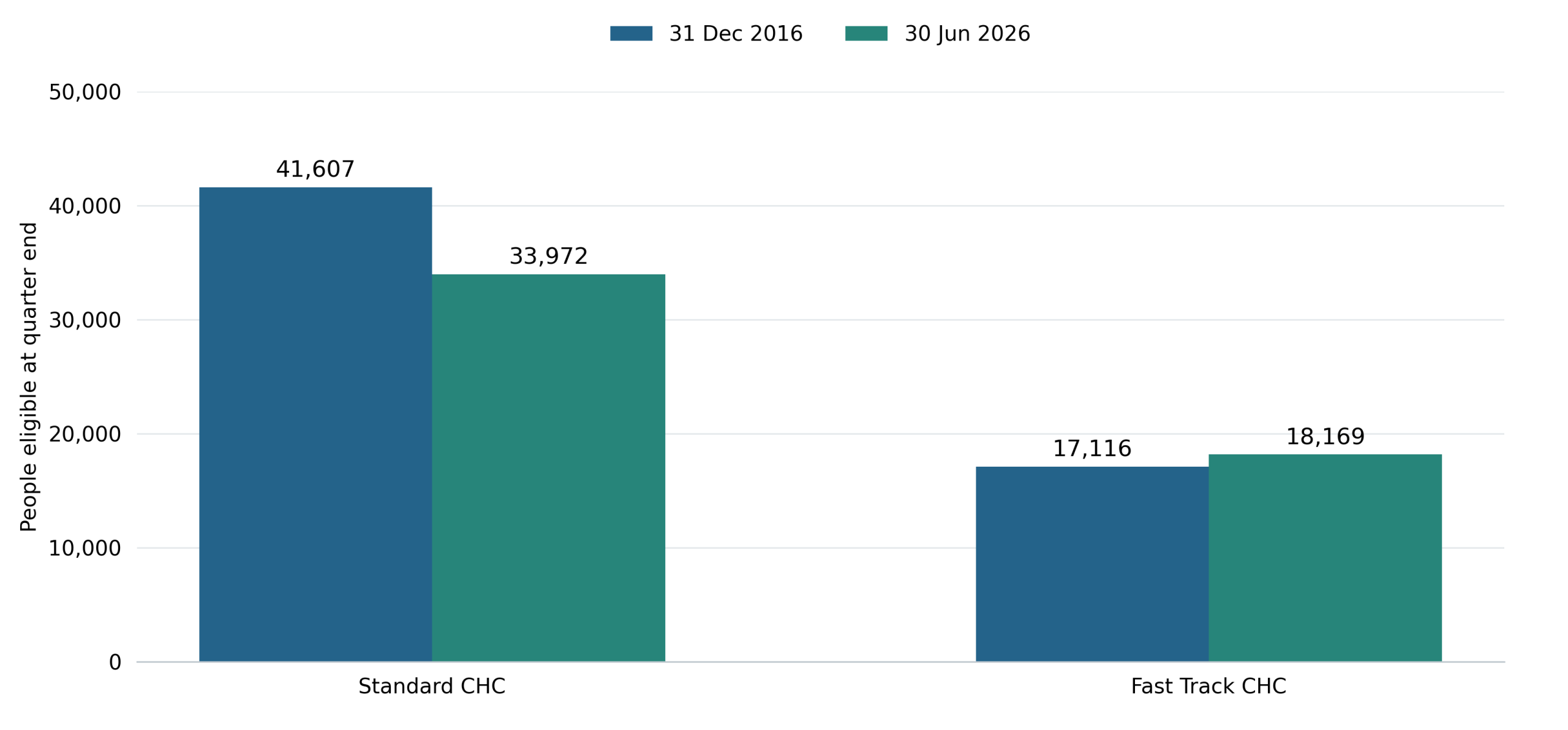
Source: NHS Digital (2017), Q3 2016/17, Tables 2.1–2.3; NHS England (2026b), Q1 2026/27, 1.1 Snapshot, England. Changes are review calculations. Collection and reporting arrangements differ across periods. Stock reflects entrants and exits and is distinct from new eligibility or assessment conversion. GL17 remains historical context and is not counted as an additional core study.
Appendix J. Integration of the disparity figures
This display records how the figures contribute to the convergent integrated synthesis. Themes refer to Appendix G; source identifiers refer to the evidence matrices. Numerical and experiential findings arise from different populations and periods. The integrated statements therefore address shared processes, rather than explaining an individual outcome with an aggregate statistic.
Contribution |
Numerical finding |
Experiential evidence |
Integrated interpretation |
Limits and missing evidence |
|---|---|---|---|---|
Figure 1: referral timeliness and backlog |
England, Jan–Mar to Apr–Jun 2026: completed Standard referrals exceeding 28 days increased from 25.8% (4,275/16,576) to 32.6% (5,519/16,954). Overdue incomplete referrals rose from 1,373 to 2,229. (NHS England, 2026a, 2026b) |
Experience reports describe difficulty obtaining updates, repeated explanation and uncertainty. Lambeth interviews also identify clear explanations and regular contact as helpful. (Healthwatch Enfield, 2020; Healthwatch Gateshead and Newcastle, 2018; Healthwatch Lambeth, 2023; Parkinson’s UK and Continuing Healthcare Alliance, 2016) |
Complementary: administrative records show delayed and unresolved activity; experiential accounts show how communication and support can affect navigation of a waiting process. Together they support examining timeliness and information across the pathway. |
Completed referrals and outstanding snapshots are distinct measures. Neither identifies the reported carers or quantifies their distress. Backlog growth does not establish why cases remain unresolved. |
Figure 2: assessment eligibility |
Across the three selected quarters, England recorded 20.8%, 16.7% and 17.7%; Cheshire and Merseyside 25.5%, 19.9% and 16.7%; Warrington 28.3%, 16.0% and 9.2%. Local counts and denominators appear in Figure 2. (NHS England, 2024, 2026a, 2026b) |
Mixed methods evidence describes local relationships, knowledge and commissioning processes alongside variation partly associated with age and deprivation. (Hutchings et al., 2025) |
Complementary: recorded geographical differences sit alongside evidence of variation in how CHC operates locally. This supports investigating consistency of access and decision processes; it does not identify the explanation for each plotted difference. |
Unadjusted proportions; small local denominators; selected periods; nested populations. Different assessed needs or referral composition remain alternative explanations. Lower eligibility alone does not establish incorrect decisions or inequity. |
Challenge-stage comparison in Results |
Combined Jan–Mar and Apr–Jun 2026 completed local resolutions resulting in eligibility: Cheshire and Merseyside 4/103 (3.9%); England 196/1,417 (13.8%). (NHS England, 2026a, 2026b) |
Selected investigations document procedural failures and remedies; experience reports describe information needs around challenge. (Healthwatch Gateshead and Newcastle, 2018; Parliamentary and Health Service Ombudsman, 2020) |
Complementary: the challenge pathway has its own recorded outcomes and experiences. It must remain visible after the initial eligibility decision, including where the outcome is unresolved or remedy implementation is unknown. |
Completed local resolutions, not unique people or IRP decisions. Selected challenged cases cannot estimate the accuracy of all initial decisions. Procedural remedies are distinct from funding eligibility. |
Figure I1: historical pathway composition |
December 2016 to June 2026: Standard recipient stock 41,607 to 33,972 (−18.4%); Fast Track 17,116 to 18,169 (+6.2%). (NHS Digital, 2017; NHS England, 2026b) |
No linked experiential explanation is available for these endpoint changes. |
Contextual: combined recipient totals can conceal different movements in Standard and Fast Track. Keep pathways distinct when interpreting access and the timing of care. |
Selected snapshots, not a continuous harmonised series. Stock includes entrants and exits; it does not identify awards, withdrawals or reasons for change. GL17 remains outside the core synthesis. |
Interpretive conclusion: the disparities warrant explanation and transparent monitoring. Their integration with experiential evidence supports treating CHC as a pathway of access, waiting, decision, implementation and challenge. The available data do not establish whether otherwise comparable individuals receive different decisions, nor how much of the recorded variation is unjust or avoidable.
Appendix K. Reconciliation evidence and reporting amendment
10 October 2026. The initial reconciliation added ten database sources and two restricted grey components. The subsequent 62-record resolution is now closed at record level: 11 eligible reports, two supporting documentary reports, seven context entries, one companion, 28 reports not retrieved and 13 exclusions after source screening. The 11 eligible reports comprise ten published-abstract reports and the supplied Dalingwater full text. The additions inform the synthesis within their reporting limits. Historical decisions remain in the audit ledger; Appendix L reconciles the whole available inventory.
K.1 Additional findings for RQ1–RQ4
Professional evidence adds a distinct perspective. Georgiadis, Corrigan and Speed (2017; online 2016) describe how panel practice, professional disagreement and placement limitations were experienced by staff. Rotherham’s adult service evidence similarly identifies tensions around ratification and joint working, alongside improvements in collaboration (Rotherham Borough Council, 2012). These explanations do not establish whether individual decisions were wrong. England-attributable inquiry evidence adds accounts of participation and challenge (All Party Parliamentary Group on Parkinson’s, 2013); its UK-wide submissions and selected testimony limit aggregation.
Fast Track implementation extends beyond approval. The Ashford audit reports 41 approvals among 42 applications and 39 decisions within 48 hours; preferred-place outcomes are a separate measure (Thirukkumaran et al., 2012). Southampton’s before/after evaluation reports a shorter mean discharge interval, but cannot isolate an intervention effect (Vardon, Giwa and Baylis, 2017). The Norwich audit identifies a CHC assessment wait without supplying its subgroup denominator (Tan et al., 2014).
Communication and recognition also enter the implementation pathway. Stapleton et al. (2025) and Hill et al. (2023) report documentation measures among Fast Track discharges. Glasgow et al. (2023) combine a 72-referral case-note evaluation with 13 staff interviews describing barriers. Turner et al. (2026) identify possible missed referrals in a highly selected retrospective sample. These findings support investigation of pathway mechanisms; they do not establish nationally representative rates, patient-reported experience or causal consequences. Clayton (2025) provides a small adult-service example of CHC funding being translated into staffing; Dowler (2014) describes retrospective-claim finance and managerial consequences.
K.2 Evidence, appraisal and risk-of-bias matrix
CHC-0112 — Georgiadis, Corrigan and Speed (2017; online 2016)
Domain |
Assessment |
|---|---|
Design / available report |
Qualitative ethnography. Complete accepted manuscript obtained from Essex repository on 10 October 2026 |
Journey / themes |
J3/J6 / T2;T4;T5;T7 |
Extracted finding |
Eight professionals in one English acute trust described funding-panel difficulties, restricted placement options and moral distress. These are professional accounts, not an audit of whether individual refusals were correct. |
Locator |
Methods and Findings; June 2015 fieldwork |
Appraisal basis |
MMAT qualitative: approach, collection, grounding, interpretation and coherence supported by the full report. Reflexivity and transferability remain limited. |
Risk and interpretive boundary |
One trust; selected staff perspective; limited reflexivity; patients and carers not interviewed for this report. |
CHC-0138 — Tan et al. (2014)
Domain |
Assessment |
|---|---|
Design / available report |
Published conference audit abstract. Complete published abstract checked at Oxford University Press on 10 October 2026 |
Journey / themes |
J3 / T2 |
Extracted finding |
In an audit of 99 medically fit older inpatients, the mean wait from referral to CHC-team assessment was 8.75 days. The number referred to CHC was not separately reported. |
Locator |
Sampling methods and Results |
Appraisal basis |
Descriptive audit: cohort selection described; CHC subgroup coverage, measurement verification, missingness and analysis insufficiently reported. No overall grade. |
Risk and interpretive boundary |
Single hospital; subgroup denominator unavailable. Cohort complications, deaths and total excess bed costs cannot be attributed to CHC delays. |
CHC-0148 — Stapleton et al. (2025)
Domain |
Assessment |
|---|---|
Design / available report |
Published quality-improvement abstract. Complete publication abstract supplied by reviewer; linked imported DOI, publisher access blocked in this session |
Journey / themes |
J6 / T1;T4 |
Extracted finding |
Among 68 Fast Track-funded discharges, recorded Universal Care Plan completion increased from 33% to 75% across the reported quarters following education and template prompts. |
Locator |
Methods and Results |
Appraisal basis |
Audit/improvement source assessment: aim and cohort link clear; period-specific coverage, missingness and concurrent changes unclear. No overall grade. |
Risk and interpretive boundary |
Quarter-specific numerators and denominators unavailable; uncontrolled changes; documentation completeness is not measured lived experience or care quality. |
CHC-0149 — Clayton (2025)
Domain |
Assessment |
|---|---|
Design / available report |
Published service-development abstract. Complete publication abstract supplied by reviewer; linked imported DOI |
Journey / themes |
J6 / T4;T5 |
Extracted finding |
An English hospice developed a young-adult service for four people. CHC funding was explicitly obtained for the motivating young person to support staffing; the abstract does not establish CHC funding for all four. |
Locator |
Background, Methods and Conclusions |
Appraisal basis |
Documented implementation account: setting and funding action explicit; selection, outcome measurement and completeness unclear. No overall grade. |
Risk and interpretive boundary |
Very small service description; ages and systematic outcome evaluation absent. Use only the separable adult service and identified funding implementation account. |
CHC-0158 — Hill et al. (2023)
Domain |
Assessment |
|---|---|
Design / available report |
Published discharge-summary re-audit abstract. Complete publication abstract supplied by reviewer; linked imported DOI |
Journey / themes |
J6 / T1;T4 |
Extracted finding |
A re-audit examined 181 Fast Track discharge summaries. Recorded GP instructions increased from 46% to 62% and anticipatory prescriptions from 80% to 94%, while follow-up-plan documentation fell from 61% to 47%. |
Locator |
Method and Results |
Appraisal basis |
Descriptive re-audit: current sampling period explicit; criteria validation, completeness and comparability to earlier audits unclear. No overall grade. |
Risk and interpretive boundary |
Earlier audit denominators and adjustment unavailable. Readmission wording conflicts with the reported 9% and 16%; withhold that direction and any causal explanation. |
CHC-0160 — Glasgow et al. (2023)
Domain |
Assessment |
|---|---|
Design / available report |
Published mixed-methods service-evaluation abstract. Complete publication abstract retained in imported record; title/DOI and England setting explicit |
Journey / themes |
J2/J6 / T1;T2;T4;T5;T7 |
Extracted finding |
Of 72 Bristol Fast Track referrals, 27 died in hospital, 30 were discharged with funding and 15 without it. Thirteen staff interviews identified paperwork, communication, recognition and staffing barriers. |
Locator |
Methods and Results |
Appraisal basis |
MMAT components: qualitative collection/coding described; sampling and grounding unclear. Quantitative measurement/missingness unclear; rationale for mixed methods implicit and integration insufficiently reported. No overall grade. |
Risk and interpretive boundary |
Conference-level reporting; missingness, sampling and formal integration unclear. The printed end date “31 April” is impossible; retain March–April 2021 with exact dates unverified. These are not causal effects. |
CHC-0209 — Vardon, Giwa and Baylis (2017)
Domain |
Assessment |
|---|---|
Design / available report |
Published before/after service-improvement abstract. Complete published abstract checked at Oxford University Press on 10 October 2026 |
Journey / themes |
J3/J6 / T2;T5 |
Extracted finding |
A Southampton discharge improvement programme reported mean days to discharge for Fast Track patients falling from 20 to 11. Overall evaluation samples were 50 before and 41 after; Fast Track subgroup sizes were not supplied. |
Locator |
Innovations and Evaluation |
Appraisal basis |
Nonrandomised improvement evidence: intervention and timing described; subgroup coverage, comparable baseline, confounding control and missingness unclear. No overall grade. |
Risk and interpretive boundary |
Multiple simultaneous interventions, small uncontrolled samples and unclear case mix. Overall complaints and adverse events are not Fast Track-specific outcomes. |
CHC-0251 — Turner et al. (2026)
Domain |
Assessment |
|---|---|
Design / available report |
Published retrospective comparative audit abstract. Complete publication abstract supplied and imported; retained citation records March 2026 issue, before search cutoff |
Journey / themes |
J1/J2 / T2;T3;T7 |
Extracted finding |
The Bristol/Weston audit compared 81 Fast Track referrals with a selected non-referred cohort. Only 33 of 176 reviewed non-referred records remained after exclusions. Retrospective SPICT assessment suggested missed opportunities to recognise poor prognosis and refer. |
Locator |
Methods and Results |
Appraisal basis |
Nonrandomised descriptive comparison: selection and missing-data concerns; retrospective classification unclear; no adjusted causal estimate; no overall grade. |
Risk and interpretive boundary |
Heavy exclusions including 89 incomplete records; unmatched cohorts and retrospective classification. The 57.1% eligibility claim has an unclear denominator and is withheld from review-calculated rates. Admission/death/discharge windows differ within the abstract. |
CHC-0271 — Thirukkumaran et al. (2012)
Domain |
Assessment |
|---|---|
Design / available report |
Published hospice case-note audit abstract. Complete publication abstract supplied by reviewer; linked imported DOI and Ashford setting |
Journey / themes |
J2/J6 / T2;T4 |
Extracted finding |
In 42 hospice Fast Track applications, 41 were approved and 39 received a decision within 48 hours. Preferred place of care/death was reported achieved for 28 of 42 people. |
Locator |
Methodology and Results |
Appraisal basis |
Descriptive audit: sample and application counts explicit; representativeness, outcome verification and missingness unclear. No overall grade. |
Risk and interpretive boundary |
Small selected hospice sample; timing definitions, missingness and outcome verification unclear. Approval, preferred-place outcomes and subsequent death are distinct measures. |
CHC-0284 — Dowler (2014)
Domain |
Assessment |
|---|---|
Design / available report |
Documented financial investigation in trade press. Full article supplied by reviewer; original account-based investigation identified |
Journey / themes |
J8 / T5 |
Extracted finding |
An investigation of retrospective CHC claim provisions and commissioner accounts described financial liabilities and managerial work after the organisational transition from PCTs to CCGs. |
Locator |
Full supplied article; 23 May 2014 |
Appraisal basis |
Custom documentary assessment: author, date and account-based basis identified; coverage, reproducibility and completeness limited. Financial figures are not patient decision outcomes. |
Risk and interpretive boundary |
Selected financially challenged organisations and incomplete analytic methods. Separate provisions, contingent liabilities, actual expenditure and editorial/quoted interpretations. Shared accounts may recur in other HSJ reports. |
GL32 — Rotherham Borough Council (2012)
Domain |
Assessment |
|---|---|
Design / available report |
Local scrutiny with professional evidence and mixed-age survey. Complete supplied PDF reassessed 10 October 2026 |
Journey / themes |
J3/J4/J5/J7 / T1;T5;T6;T7 |
Extracted finding |
Adult service sections record professional concerns about panel ratification, communication and interpretation of needs alongside examples of improving joint work. Adult age-band figures are reported separately. |
Locator |
Adult professional/service sections, especially pp.7–11; exclude unattributed survey pp.12–14 |
Appraisal basis |
Custom scrutiny assessment: authority and documentary basis clear; recruitment, testimony verification and analytic completeness limited. Extract only adult-attributable components. |
Risk and interpretive boundary |
Mixed-age survey includes age 17: exclude its unattributed quotations and aggregate experience results from adult synthesis. Institutional testimony is not a verified decision-error rate. |
Source: supplied PDF; original public download URL not verified in this reconciliation.
GL37 — All Party Parliamentary Group on Parkinson’s (2013)
Domain |
Assessment |
|---|---|
Design / available report |
Documented inquiry with oral/written evidence. Complete supplied Failing to care report, 37 PDF pages |
Journey / themes |
J1/J3/J4/J5/J6 / T1;T2;T3;T5;T6;T7 |
Extracted finding |
The inquiry describes difficulty obtaining information, participating in assessment and navigating challenges. It combines oral hearings and written submissions; only evidence attributable to England is admitted to this review. |
Locator |
Inquiry scope/methods pp.14–15; findings pp.16–31; contributor list p.35 |
Appraisal basis |
Custom inquiry assessment: scope and hearings described; systematic selection and analysis unclear, advocacy interests explicit. Use England-specific testimony, not national prevalence estimates. |
Risk and interpretive boundary |
UK submissions are mixed within an England-focused inquiry; withhold aggregate survey percentages without geographic/denominator verification. Selected testimony and advocacy remit limit representativeness; reused material in GL02 is counted once. |
Source: supplied PDF; original public download URL not verified in this reconciliation.
K.3 Selection and sensitivity interpretation
Excluding abstract-only contributions would remove most audit and service-improvement illustrations while retaining the recovered professional ethnography, Dalingwater’s journal article and the other full-report evidence. Excluding institutional testimony and financial reporting would narrow support for organisational explanations. This is a qualitative sensitivity consideration, not a formal robustness analysis. No new pooled statistics are calculated from these additions. Unretrieved reports provide no assumed results.
Detailed longitudinal patient/carer research remains limited within the assembled evidence. Dalingwater adds original professional interviews and selected published testimonials, but does not provide a prospectively recruited patient cohort followed across the pathway. The assessor survey, 5Q evaluation, dementia-funding study and policy thesis remain unavailable under the documented retrieval outcome and are excluded from the current synthesis, without implying that they are substantively ineligible. Exact source identities for GL34–GL36 remain unverified; newly located local scrutiny documents are retrieval leads and are not silently substituted for those entries.
Appendix L PRISMA accounting and final article resolution
This appendix reconciles the retained search archive and source inventory as at 10 October 2026. Figure P1 uses record and source-entry units because the available documentation does not support a conventional completed PRISMA 2020 report/study flow. Unverified values are not replaced with zero. The historical 105-entry working list is not used as a full-text assessment denominator.
L1 Database record accounting
Stage or disposition |
n |
Interpretation |
|---|---|---|
Imported archive references |
996 |
Not verified complete executed search yields |
Imported copies removed |
451 |
Deduplication within the retained archive |
Records after deduplication |
545 |
996 − 451 |
Excluded at title |
342 |
Title-screening route |
Context at title |
3 |
Outside the core synthesis |
Abstract or bibliographic screening |
200 |
545 − 342 − 3 |
Subsequently excluded |
80 |
32 abstract/bibliographic; 15 available-source; 13 final source-screening; 12 source-follow-up; 8 historical working-list exclusions |
Subsequent context |
55 |
Contextual material, secondary summaries or citation/source follow-up; no core contribution |
Duplicate source fragments |
4 |
CHC-0454, CHC-0455, CHC-0528, CHC-0537; not distinct reports |
Reports not retrieved |
28 |
17 earlier unsuccessful retrievals plus 11 returned user exclusions |
Retained database entries |
33 |
28 core + 2 supporting documentary + 3 companions |
Disposition check |
200 |
80 + 55 + 4 + 28 + 33 = 200 |
The 13 returned source-screening exclusions comprise 12 entries with no extractable relevant findings and one with no CHC-specific findings. These are assessment reasons, not 13 verified full-text exclusions. The 80 later exclusions combine documented source stages; an exact full-text exclusion total cannot be separated reliably from the historical records.
L2 Grey sources and overlap between routes
Inventory disposition |
n |
Counting rule |
|---|---|---|
Registered grey entries |
37 |
An inventory count, not all grey search hits |
Core grey entries |
18 |
GL01–GL16, GL32 adult component and GL37 England-attributable component |
Context or historical entries |
16 |
GL17–GL31 and GL33 |
Unverified identities |
3 |
GL34, GL35 and GL36: not admitted; no findings extracted |
Core entries also in database route |
4 |
GL04/CHC-0341; GL13/CHC-0375; GL14/CHC-0469; GL15/CHC-0458 |
Additional grey core entries |
14 |
18 − 4 |
Combined retained source/companion entries |
47 |
33 database + 14 additional grey |
Core synthesis source entries |
42 |
28 database core + 18 grey core − 4 aliases |
Supporting documentary entries |
2 |
CHC-0260 and CHC-0261, same Greater Manchester finance-report family |
Linked companion entries |
3 |
CHC-0144, CHC-0178 and CHC-0252; no independent contribution |
GL34 is recorded only as “Three local Healthwatch CHC survey 2022”; GL35 as “West Berkshire CHC scrutiny material”; GL36 as “Sheffield CHC local material”. Public-source searches located possible local scrutiny documents but did not establish that they were the inventory items previously considered. The three entries remain identifiable audit gaps, not three proven ineligible studies. They contribute no findings and cannot be used to support a claim that all grey literature has been resolved.
GL16 represents four retained quarterly releases within one administrative collection. GL08 and GL09 share NAO evidence; GL37 material is reused in GL02. Reports, datasets and study families therefore cannot be counted interchangeably. The 47 retained entries are not a verified report count, and the 42 core entries are not an independent-study count.
L3 Final resolution of the 62 article records
Disposition |
n |
|---|---|
Eligible reports |
11 |
Supporting documentary reports |
2 |
Context entries |
7 |
Companion entry |
1 |
Reports not retrieved |
28 |
Excluded after source screening |
13 |
Total |
62 |
The returned 25 decisions were one inclusion (CHC-0256, Dalingwater) and 24 exclusions: 11 not retrieved, 12 no extractable relevant findings and one no CHC-specific findings. This closes that subset. It does not mean all 62 reports were retrieved in full; ten of the eligible reports were assessed at the available published-abstract level.
Reports not retrieved: CHC-0075, CHC-0080, CHC-0113, CHC-0119, CHC-0133, CHC-0136, CHC-0262, CHC-0263, CHC-0264, CHC-0265, CHC-0266, CHC-0267, CHC-0268, CHC-0286, CHC-0291, CHC-0292, CHC-0294, CHC-0295, CHC-0296, CHC-0297, CHC-0298, CHC-0299, CHC-0300, CHC-0301, CHC-0304, CHC-0311, CHC-0319, CHC-0538.
L4 Dalingwater extraction and appraisal update
Dalingwater (2018) was assessed from the supplied complete journal PDF, printed pages 43–60, on 10 October 2026. Its inclusion resolves an existing imported record; it adds no identification record. The study contributes to all four review questions through 31 manager interviews and 40 published testimonials. Original professional evidence and secondary experience accounts remain distinct.
Forty published testimonials and 31 manager interviews identify referral barriers, information/training problems, inconsistent interpretation, managed-needs concerns, pressured reviews, financial boundaries and contested appeals. Selected accounts describe refusal of assessment, withdrawal and reinstatement with retrospective funding. Managers generally defend local assessment/training and deny unlawful rationing, while describing subjectivity, inconsistent reporting, joint funding and alternative services as explanations for variation. The author does not establish that geographic variation necessarily represents inequity.
Qualitative appraisal criterion |
Judgment |
|---|---|
Clear research question |
Yes |
Data address the question |
Yes, within exploratory scope |
Appropriate qualitative approach |
Yes |
Appropriate data collection |
Unclear |
Findings grounded in data |
Unclear |
Interpretations substantiated |
Yes, for exploratory accounts |
Coherence of collection analysis and interpretation |
Unclear |
Managers: 31 of 130 invited teams participated; 99 declined or were unreachable. Published testimonials are selected secondary accounts, not prospectively recruited patient/carer interviews. Testimonial selection, identity/deduplication, interview recording/transcription, coding, reflexivity and ethics procedures are not reported in sufficient detail. No need-adjusted locality comparison or adjudication of individual eligibility; manager accounts may be socially desirable. Interpret proposed explanations and disagreements, not verified causal effects or national error/award rates.
Final article extraction, criterion-level appraisal, narrative risk-of-bias and contribution matrices are held in CHC_Final_Article_Decisions_and_Dalingwater_Appraisal.zip. No overall quality score or independent second-human-reviewer agreement is claimed. Appraisal of the ten additional eligible conference reports remains limited by abstract reporting.
L5 Reporting limits
The available-record disposition flow is arithmetically reconciled. Complete database and grey-search yields, exact executed strategies and limits, a defensible total of reports sought and assessed in full, and a verified independent-study total remain unavailable. A standard completed PRISMA 2020 flow should replace Figure P1 only if the underlying source records are recovered. These gaps are not reported as zero, source entries are not equated with studies, and comprehensive reproducibility is not claimed from the retained archive alone.
Appendix M Retrospective transformation summary
Prepared 10 October 2026 after final source reconciliation. Each row links a bounded extracted finding to its textual interpretation and mapped themes. The original full extraction and locators remain above and in accompanying files. This summary demonstrates the final source-to-theme relationship; it is not an original timestamped line-by-line coding history. Quantities are preserved; participant, investigator and author interpretations are not recoded as verified causal effects.
Source result and locator |
Transformed statement |
Initial code and theme |
|---|---|---|
CHC-0094: 129/439 died before discharge; Results. |
In one 2021 Fast Track referral cohort, 29.4% died before discharge. This describes the referred cohort and does not establish death caused by funding delay. |
Limited time to implement care; T2. |
GL06: 4/12 informed about appeal; printed p.17. |
Four of twelve respondents answering this question reported receiving appeal information. This is a selected item response, not a participation rate or appeal success estimate. |
Understanding challenge options; T1/T6. |
GL16: Warrington 6/65 newly eligible Standard assessments, Q1 2026/27, 1.3 In Quarter. |
Warrington recorded 9.2% eligibility among 65 Standard assessments in this quarter. Small, unadjusted locality data cannot predict a particular person’s eligibility or establish wrongful refusal. |
Recorded locality difference; T3. |
Final source to theme mappings
Entry |
Extracted finding retained |
Bounded textual statement |
Themes and interpretive boundary |
|---|---|---|---|
CHC-0043 |
Three selected rural adult cases described funding awards that were difficult to implement because agencies could not be sourced. Families supplied additional care; one person with COPD and Alzheimer’s disease moved to a fully funded care home distant from family. Deterioration and distress were clinician-reported, without independent outcome measurement. |
Clinical case series, three rural adults. Awards did not ensure providers could be sourced; families supplied care. One dementia case involved a distant placement. Selected clinician accounts. |
T4, T7 |
CHC-0065 |
Phase 2 included 104 people: 94 were discharged home, with a median wait of one day. Ten died on the ward or were judged too near death/unstable to transfer (Results wording). Median survival among those discharged was nine days. Fifty of 104 had a CHC application, of which 41 were approved. Equipment, communication and funding sequencing changed together; selected family feedback described support and a peaceful home setting. |
Uncontrolled improvement project. Phase 2: 94/104 discharged home; median wait one day. CHC approved for 41/50 applicants. Selected pathway; several changes occurred together. |
T2, T4 |
CHC-0094 |
Among 439 Fast Track referrals in 2021, 413 died during follow-up; median survival was 15 days. Death before discharge occurred in 129/439 (29.4%). Median survival was 18 days for approved applications and 25 for deferred applications (reported p=0.0013); categories overlap and comparisons are unadjusted. |
Prospective local evaluation, 439 Fast Track referrals. Median survival 15 days; 129 died before discharge. Approved/deferred survival differed without adjustment; no causal estimate. |
T2 |
CHC-0112 |
Eight professionals in one English acute trust described funding-panel difficulties, restricted placement options and moral distress. These are professional accounts, not an audit of whether individual refusals were correct. |
Ethnography, eight professionals at one acute trust. Funding panels and placement constraints contributed to reported moral distress. Patient/carer perspectives absent. |
T2, T4, T5, T7 |
CHC-0138 |
In an audit of 99 medically fit older inpatients, the mean wait from referral to CHC-team assessment was 8.75 days. The number referred to CHC was not separately reported. |
Audit abstract, 99 medically fit older inpatients. Mean CHC assessment wait 8.75 days; CHC subgroup denominator not reported. |
T2 |
CHC-0148 |
Among 68 Fast Track-funded discharges, recorded Universal Care Plan completion increased from 33% to 75% across the reported quarters following education and template prompts. |
Improvement abstract, 68 Fast Track discharges. Recorded care-plan completion rose 33% to 75%; quarter denominators absent. Documentation is not measured lived experience. |
T1, T4 |
CHC-0149 |
An English hospice developed a young-adult service for four people. CHC funding was explicitly obtained for the motivating young person to support staffing; the abstract does not establish CHC funding for all four. |
Service-development abstract, four young adults. CHC staffing funding explicit for the motivating person, not verified for all four; no systematic outcome evaluation. |
T4, T5 |
CHC-0157 |
The home-care service reported 156 referrals in its first year, 75 people supported to die at home, and a referral-to-care interval of 24–48 hours. |
Service-evaluation abstract, 156 referrals. Seventy-five supported to die at home; reported referral-to-care interval 24–48 hours. No concurrent comparator. |
T2, T4 |
CHC-0158 |
A re-audit examined 181 Fast Track discharge summaries. Recorded GP instructions increased from 46% to 62% and anticipatory prescriptions from 80% to 94%, while follow-up-plan documentation fell from 61% to 47%. |
Re-audit abstract, 181 summaries. GP instructions and anticipatory prescriptions improved; follow-up documentation declined. Conflicting readmission wording withheld. |
T1, T4 |
CHC-0160 |
Of 72 Bristol Fast Track referrals, 27 died in hospital, 30 were discharged with funding and 15 without it. Thirteen staff interviews identified paperwork, communication, recognition and staffing barriers. |
Mixed methods abstract, 72 referrals and 13 staff interviews. Twenty-seven died in hospital; paperwork, recognition and communication barriers reported. Integration incompletely described. |
T1, T2, T4, T5, T7 |
CHC-0165 |
All reported first-month care was delivered within 48 hours; 88.9% achieved preferred place of death. |
First-month service abstract. Reported care within 48 hours for all cases and preferred death location for 88.9%; denominators unavailable. |
T2, T4 |
CHC-0173 |
The audit reports that 62.5% of community palliative-care referrals occurred in a Fast Track discharge context. Extract only this CHC-related observation. |
Cirrhosis audit abstract, 52 deaths. Fast Track context reported for 62.5% of community palliative referrals; subgroup denominator absent. Linked CHC-0178 counted once. |
T2, T4 |
CHC-0188 |
Reported care within 48 hours was 99%; preferred-place achievement rose from 79% to 90%; 95% of referrals were said to meet local service criteria. |
Pilot abstract. Reported 99% care within 48 hours; preferred-place achievement rose 79% to 90%. Denominators absent; local criteria are not national eligibility. |
T2, T4 |
CHC-0190 |
Reported total length of stay decreased from 22 to 16 days; admission-to-Fast-Track decision from 15 to 13 days; Fast Track process time from seven to 2.5 days. Estimated value of 2,052 bed days at £300/day was £615,600. |
Improvement abstract. Reported stay declined 22 to 16 days and Fast Track process seven to 2.5 days. Uncontrolled; bed-day valuation is not cash savings. |
T2, T4 |
CHC-0194 |
The CHC-funded service supported 32 patients and delivered 1,147 care hours. Reported Fast Track discharge delay fell from 15.3 days to less than two days. |
Homecare abstract, 32 patients. Reported discharge delay fell 15.3 days to under two; baseline sampling and case mix unspecified. |
T2, T4, T5 |
CHC-0204 |
Staff reported anxiety about discharge documentation, particularly CHC funding paperwork. A discharge educator and patient leaflet were introduced. Broader hospice discharge results are not extracted as CHC-specific effects. |
Staff-survey/audit abstract. CHC paperwork associated with staff anxiety; education introduced. Broader discharge outcomes not attributed specifically to CHC. |
T1, T2, T4 |
CHC-0209 |
A Southampton discharge improvement programme reported mean days to discharge for Fast Track patients falling from 20 to 11. Overall evaluation samples were 50 before and 41 after; Fast Track subgroup sizes were not supplied. |
Before/after abstract, overall samples 50/41. Fast Track discharge time reported 20 to 11 days; subgroup sizes absent and interventions simultaneous. |
T2, T5 |
CHC-0215 |
All 189 reported referrals were Fast Track funded. Of these, 109 came from home; 69% died within four weeks. Two hospice and three hospital transfers were reported. People surviving longer continued care in the nursing home. |
Diversional-bed abstract, 189 funded referrals. Sixty-nine percent died within four weeks. Selected funded referrals cannot estimate eligibility likelihood. |
T2, T4 |
CHC-0240 |
Following CHC review and withdrawal, three men with acquired brain injury moved into adapted community housing with multi-agency and family involvement. One later lived alone without support; two remained in shared supported housing. A proposal for residential placement on cost grounds was reported for one. |
Case-series abstract, three men after CHC withdrawal. Community resettlement outcomes reported; funding sustainability questioned. No adjudication of withdrawal correctness. |
T4, T5 |
CHC-0251 |
The Bristol/Weston audit compared 81 Fast Track referrals with a selected non-referred cohort. Only 33 of 176 reviewed non-referred records remained after exclusions. Retrospective SPICT assessment suggested missed opportunities to recognise poor prognosis and refer. |
Retrospective audit abstract. Eighty-one referred cases compared with selected non-referred records; 33/176 remained after exclusions. Missed-opportunity interpretation limited by missingness. |
T2, T3, T7 |
CHC-0256 |
Forty published testimonials and 31 manager interviews identify referral barriers, information/training problems, inconsistent interpretation, managed-needs concerns, pressured reviews, financial boundaries and contested appeals. Selected accounts describe refusal of assessment, withdrawal and reinstatement with retrospective funding. Managers generally defend local assessment/training and deny unlawful rationing, while describing subjectivity, inconsistent reporting, joint funding and alternative services as explanations for variation. The author does not establish that geographic variation necessarily represents inequity. |
Full qualitative study: 40 published testimonials and 31/130 invited manager teams. Contrasting assessment and appeal accounts; selection, coding and reflexivity incompletely reported. |
T1, T2, T3, T4, T5, T6, T7 |
CHC-0271 |
In 42 hospice Fast Track applications, 41 were approved and 39 received a decision within 48 hours. Preferred place of care/death was reported achieved for 28 of 42 people. |
Hospice audit abstract, 42 applications. Forty-one approved; 39 decisions within 48 hours; preferred place achieved for 28. Small selected population. |
T2, T4 |
CHC-0284 |
An investigation of retrospective CHC claim provisions and commissioner accounts described financial liabilities and managerial work after the organisational transition from PCTs to CCGs. |
Trade-press financial investigation. Retrospective claims and commissioner provisions described. Documentary contribution; provisions are not awards or expenditure. |
T5 |
CHC-0308 |
Clinicians attributed 13 of 77 discrepancies between preferred and actual place of death to CHC delays. Preferred place was achieved for 349 of 426 people with a recorded preference. |
Audit abstract, 708 deaths. Clinicians attributed 13/77 unmet recorded preferences to CHC delays; preferences unknown for 282. Attribution not independently verified. |
T2, T4 |
GL01 |
Missing care plans, unsupported package reductions and additional charges resulted in some families funding care or providing it themselves. Ms E reimbursement recommended: approximately £187,000 professional care and £90,000 family care. Ms P approximately £33,000 recommended repayment. Mr S approximately £250,000 reimbursement agreed through early resolution. |
Selected complaint investigations. Missing care plans, unsupported reductions and retrospective review failures documented; remedies reported. Cannot estimate population error rates. |
T1, T4, T6, T7 |
GL02 |
42% of surveyed applicants reported waiting more than 28 days; 35% reported MDT eligibility recommendation followed by panel rejection. 66% of survey respondents considered assessors’ condition knowledge limited; 80% of professionals considered DST unsuitable or in need of improvement. |
Advocacy surveys: 274 individual/family and 409 professional responses, plus FOI. Delays and assessment concerns reported. Self-selection, variable denominators and reused material. |
T1, T2, T4, T7 |
GL03 |
Selected accounts describe stressful assessments, exclusion from meetings, difficulty understanding decisions, persistence and fear of funding loss. The report also analyses administrative trends, but conflicting endpoint labels are withheld from numerical comparisons in this review. The overall survey response count is not the CHC experience sample. |
Secondary analysis and selected experience accounts. Stress, participation difficulties and fear of funding loss described. CHC sample unclear; conflicting numerical labels withheld. |
T4, T7 |
GL04 |
Combined caseload declined from 57,216 June 2017 to 52,008 December 2024, reported fall 9.1%. Standard conversion declined from 31.2% to 18.6%. Combined ICB eligibility rates ranged approximately 20–95 per 50,000 adults; age and deprivation explained part of sub ICB variation. Professionals also described variable awareness, interpretation, evidence collection, commissioning and relationships (full report pp.38–65). |
Mixed methods national policy research. Administrative variation accompanied by professional explanations about awareness, interpretation and commissioning. Limited ICB participation and incomplete FOI. |
T1, T2, T3, T5, T7 |
GL05 |
Respondents reported limited prior awareness, difficulty obtaining updates and explaining fluctuating or unfamiliar needs. Trusted professionals, clear explanations and regular updates supported confidence and involvement; skilled compassionate practice also reported. |
Eight interviews: one recipient and seven carers/family. Information difficulties and helpful professional support described. Small professionally recruited sample. |
T1, T2, T4, T7 |
GL06 |
Respondents described confusing information and variable understanding of financial implications and assessment. Of 12 answering the appeal information question, 4 reported being informed and 8 not informed. Of 14 answering the appeal participation question, 6 appealed and 8 did not. |
Local survey, 40 respondents. Appeal information: 4/12 informed; appeal participation: 6/14. Different question denominators; self-selection. |
T1, T6 |
GL07 |
Accounts describe poor preparation, unclear contacts, perceived inaccurate assessments, payment delays and uncertainty around funding changes. Report describes 28 as around 7% of 600 service users. The arithmetic is approximately 4.7%. |
Survey, 28 respondents including three direct recipients. Preparation, payment and funding-change concerns reported. Selection and analytical reporting limited. |
T1, T4, T7 |
GL08 |
Of 448 cases reviewed by an independent review panel in 2015/16, 122 (27%) received a recommendation for a different eligibility decision for all or part of the period reviewed. Large geographical differences and limited assurance of consistent decisions identified. |
Oversight investigation. Different-decision recommendations in 122/448 independent reviews; geographical differences documented. Selected challenges and administrative overlap. |
T3, T6 |
GL09 |
Committee challenged delays, inconsistent assessment and weaknesses in oversight, and sought clearer accountability. Oral evidence provides institutional explanations and assurances alongside criticism. |
Parliamentary oversight and hearings. Delays, assessment consistency and accountability challenged. Reuses NAO evidence; not independent population research. |
T3 |
GL10 |
Contributors raised communication, MDT invitation and evidence sharing concerns alongside the security afforded by funding. Panel emphasised training, professional communication and scrutiny of changes. |
Local scrutiny. Communication, invitations and evidence sharing raised alongside funding security. Contributor selection and outcome denominator unclear. |
T5 |
GL11 |
Council full CHC recharge cases decreased from 79 in 2023/24 to 41 in 2024/25; joint funded cases rose from 95 to 119. Report describes disputed health and social care boundaries, staff redeployment and changes to review and notice processes. |
Council scrutiny/administrative report. Full CHC recharge cases 79 to 41; joint-funded cases 95 to 119. Council perspective; disputed boundaries and inconsistent labels. |
T5 |
GL12 |
Face to face figures not supplied because review of 1,001 assessment records at 10 minutes each was estimated at around 166 hours, exceeding FOI cost limit. ICB states senior assessors have at least five years post registration experience and receive induction and mandatory training. |
Single-ICB FOI. Face-to-face data not supplied within cost limit; assessor induction and training described. Non-disclosure is not evidence of absent assessments. |
T1 |
GL13 |
One respondent described further CHC savings and pressure on council social care funding. |
Finance survey. One respondent described CHC savings pressure and council consequences. Narrow documentary extract; no CHC-specific sample denominator. |
T5 |
GL14 |
January–March 2020 delayed referrals exceeding 28 days as a proportion of all eligible patients: rural 4.4% and remote 6.1%, respectively 0.6 and 2.3 percentage points above other areas. |
Ecological analysis. Delayed-referral proportions: rural 4.4%, remote 6.1% in January–March 2020. Definitions and case mix constrain comparison. |
T2 |
GL15 |
Original plan set out £43.7m recurrent CHC savings for 2025/26. Standard CHC eligibility rate fell 27% September 2024 to September 2025. Authors estimate 293 fewer recipients than if prior rate were maintained. |
Commissioned financial review. Planned recurrent CHC savings £43.7m; Standard eligibility rate reportedly fell 27%. Conditional models; no individual validation of reductions. |
T5 |
GL16 |
Across four supplied releases (Q4 2023/24, revised Q4 2024/25, Q4 2025/26 and Q1 2026/27), combined caseload was 52,096, 51,119, 51,196 and 52,141. Standard conversion was 20.8%, 19.8%, 16.7% and 17.7%; timeliness within 28 days was 72.9%, 77.6%, 74.2% and 67.4%. Local-resolution decisions changing eligibility were 80/596, 89/631, 104/751 and 92/666. |
Administrative source family, four releases. Stock, conversion, timeliness and local-resolution outcomes extracted separately. No individual linkage; periods and definitions matter. |
T2, T3, T6 |
GL32 |
Adult service sections record professional concerns about panel ratification, communication and interpretation of needs alongside examples of improving joint work. Adult age-band figures are reported separately. |
Adult-attributable local scrutiny evidence. Panel, communication and joint-working concerns alongside improvements. Mixed-age survey aggregates and unattributed quotations excluded. |
T1, T5, T6, T7 |
GL37 |
The inquiry describes difficulty obtaining information, participating in assessment and navigating challenges. It combines oral hearings and written submissions; only evidence attributable to England is admitted to this review. |
England-attributable inquiry testimony. Information, participation and challenge difficulties described. UK aggregate percentages withheld; material reused in GL02 counted once. |
T1, T2, T3, T5, T6, T7 |
Appendix N Updated narrative sensitivity assessment
These checks describe dependence on source types in the final corpus. They are qualitative removal considerations, not independent reanalyses, statistical tests or formal certainty ratings. Retaining a theme does not establish its frequency, causal mechanism or generalisability. Specific source limitations remain applicable after removal.
Theme |
Removal consideration |
Support retained |
Effect on interpretation |
|---|---|---|---|
T1 Participation |
Remove GL02, GL06, GL07 and complaint series GL01. |
Retain GL05 interviews, CHC-0256 contrasting accounts, GL04 professional evidence and England-attributable GL37 testimony. |
Interpretation remains, with less survey breadth and no investigated checklist illustration; population frequency remains unsupported. |
T2 Timeliness |
Remove all abstract-only reports and GL01. |
Retain full CHC-0065/0094, GL16 administrative reporting, GL04 and GL14. |
Defined waits/short survival and local rapid discharge remain; many local illustrations disappear. No intervention effect or complete longitudinal experience follows. |
T3 Variation |
Remove advocacy surveys and GL03 numerical claims. |
Retain GL16, GL04 and GL08; link GL09 as shared oversight evidence. |
Recorded variation persists. Independence, case mix and referral composition prevent a decision-error or inequity estimate. |
T4 Implementation |
Remove CHC-0043 clinical cases and all service abstracts. |
Retain CHC-0065 and investigated GL01 cases; GL05, GL07 and CHC-0256 offer reported consequences with selection limits. |
Workable care remains distinguishable from funding; detailed rural/dementia illustrations and young-adult service examples are lost. |
T5 Boundaries |
Remove GL13, GL15, CHC-0284 and supporting CHC-0260/0261 financial reports. |
Retain GL04, CHC-0112 and CHC-0256 professional accounts plus adult GL32 scrutiny. |
Organisational tensions remain reported, but fiscal explanation is weaker; no causal claim of rationing is established. |
T6 Challenge |
Remove GL01 complaint series and weakly described local survey GL06. |
Retain GL08 selected independent-review outcomes, GL16 local resolutions and CHC-0256 selected challenge accounts. |
Stage-specific changed decisions remain; documented reimbursements and some communication examples are lost. Challenge outcomes cannot estimate overall correctness. |
T7 Representation |
Remove selected case reports and advocacy surveys. |
Retain GL05 with one recipient/seven carers, GL04 professional research and CHC-0256 manager/secondary testimonials. |
The direct-adult and dementia-voice gap remains; surviving evidence is not representative. Positive GL05 support and differing professional views remain visible. |
Appendix O Search and reporting closure
No complete executed database histories were recovered from the retained search audit, supplied starting document or protocol. The starting document contains proposed/illustrative strategies; these are not reported as searches run. A fully reproducible search update and prospective retention of retrieval stages would be required to support stronger comprehensive systematic-review claims. The designation has therefore been qualified rather than gaps filled with guessed queries, dates or zero counts.
Confirmed author declarations on 10 October 2026: not registered; self-funded without external support. Protocol version 5 is preserved unchanged as a companion file. Existing 5 October sole-reviewer and 10 October reconciliation deviations remain explicit. This revision also qualifies the design designation, rewrites the expanded formal review and retains the evidence matrices and appendices within one document, and adds retrospective transformation and sensitivity summaries.
PRISMA items |
Reporting status and remaining limitation |
|---|---|
1–2 Title and abstract |
Qualified evidence-review designation; structured abstract below 200 words. |
3–5 Rationale questions eligibility |
Reported in Introduction and Methods. Adult England scope and restricted source types retained. |
6–7 Sources and strategies |
Partial reporting only: archive source/counts known; complete executed strategies, limits and dates not recovered. |
8–10 Selection extraction outcomes |
Sole human reviewer with AI support disclosed; source IDs, boundaries and denominators retained. |
11–15 Appraisal synthesis missing bias certainty |
Design-specific/custom appraisal stated; final transformation and sensitivity summaries supplied; no formal reporting-bias or certainty assessment. |
16 Selection |
Retrospective counts reconcile. Detailed full-text-stage and independent-study totals remain unknown. |
17–20 Characteristics individual results synthesis |
All 42 core entries in main matrix; two support documents distinguished; full extraction and updated integration supplied. |
21–23 Bias certainty discussion |
Limitations, missing voices, selected localities and incomplete coverage explicit. |
24–27 Registration support interests data |
Unregistered and self-funded confirmed; clinician/family standpoint disclosed; protocol and materials supplied without claiming a public repository. |
Additional discussion amendment, 10 October 2026: Section 4.2 critically adapts the author’s earlier webpage using retained empirical and documentary sources. Unverified quotations and unsupported causal claims were omitted. DHSC/NHS England’s 2023 retrospective-care guidance was checked and added as policy context only. The 42 core entries, two supporting documentary entries, source-contribution grid and reconciled PRISMA accounting are unchanged. This targeted verification is not a comprehensive search update.